This name is not current. Find out more information on related names.
- Reference
- Anal.Fam.Pl. 57 (1829)
- Name Status
- Not Current
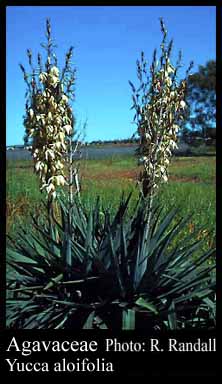
Scientific Description
Common name. Century-Plant Family.
Habit and leaf form. Herbs, or shrubs, or ‘arborescent’ (often ‘rosette trees’); evergreen. Plants succulent, or non-succulent. Perennial; plants with a basal concentration of leaves, or with terminal rosettes of leaves (then rosette-trees); rhizomatous. Self supporting, or epiphytic. Often pachycaul. Xerophytic. Leaves small to very large; alternate; spiral; leathery, or fleshy, or leathery and fleshy; sessile; sheathing; edgewise to the stem, or with ‘normal’ orientation; simple; epulvinate. Leaf blades entire; flat, or solid; linear, or lanceolate, or subulate; parallel-veined; without cross-venules. Leaves without stipules. Leaf blade margins entire, or serrate (often sharp pointed and with lateral spines). Leaves with a persistent basal meristem, and basipetal development. Vegetative anatomy. Plants without silica bodies. Stem anatomy. Nodes multilacunar. Secondary thickening absent, or anomalous; when present, from a single cambial ring.
Reproductive type, pollination. Fertile flowers hermaphrodite, or hermaphrodite and functionally male, or hermaphrodite and functionally female, or functionally male, or functionally female. Unisexual flowers present (rarely), or absent. Plants hermaphrodite (usually), or andromonoecious, or gynomonoecious, or dioecious.
Inflorescence and flower features. Flowers aggregated in ‘inflorescences’; in panicles. The terminal inflorescence unit cymose (but often condensed). Inflorescences scapiflorous, or not scapiflorous; terminal; usually large, much-branched panicles. Flowers bracteate; regular to somewhat irregular; when irregular, somewhat zygomorphic; 3 merous; cyclic; pentacyclic. Perigone tube present, or absent. Perianth of ‘tepals’; 6; 2 -whorled; isomerous; free, or joined (below); petaloid; similar in the two whorls. Fertile stamens present, or absent (in female flowers). Androecium 6. Androecial members adnate (to the perianth tube), or free of the perianth; all equal; free of one another; 2 -whorled. Androecium exclusively of fertile stamens, or including staminodes. Staminodes when present, 3. Stamens 3, or 6; isomerous with the perianth, or diplostemonous. Anthers dehiscing via longitudinal slits; usually introrse; tetrasporangiate. Pollen shed in aggregates (rarely), or shed as single grains; in Agave, occasionally in tetrads. Fertile gynoecium present, or absent (in male flowers). Gynoecium 3 carpelled. The pistil 3 celled. Gynoecium syncarpous; eu-syncarpous; superior to inferior. Ovary plurilocular; 3 locular. Gynoecium stylate. Styles 1; apical. Stigmas wet type, or dry type; papillate; Group II type, or Group III type, or Group IV type. Placentation axile. Ovules 6–50 per locule (i.e. ‘several to many’); anatropous.
Fruit and seed features. Fruit fleshy, or non-fleshy; dehiscent, or indehiscent; a capsule, or a berry. Capsules loculicidal. Seeds endospermic. Endosperm oily. Seeds without starch. Cotyledons 1. Embryo achlorophyllous (2/2 — Agave, Yucca); straight. Testa encrusted with phytomelan. Seedling. Hypocotyl internode present. Mesocotyl absent. Seedling collar not conspicuous. Cotyledon hyperphyll elongated; assimilatory; more or less circular in t.s. Coleoptile absent. Seedling cataphylls absent. First leaf dorsiventral. Primary root persistent.
Physiology, biochemistry. Photosynthetic pathway: CAM.
Geography, cytology, number of species. Holarctic and Neotropical. World distribution: widespread. X = 30 (consistently). About 400 species.
Economic uses, etc. Pulque and mescal derive from fermentation/distillation of Agave sap; and many Agave and Yucca species yield useful fibres (sisal hemp, henequen, pita, istle, ixtle, lechuguilla, keratto, etc.).