This name is not current. Find out more information on related names.
- Reference
- Esq.Règne Vég. p50 (1820)
- Name Status
- Not Current
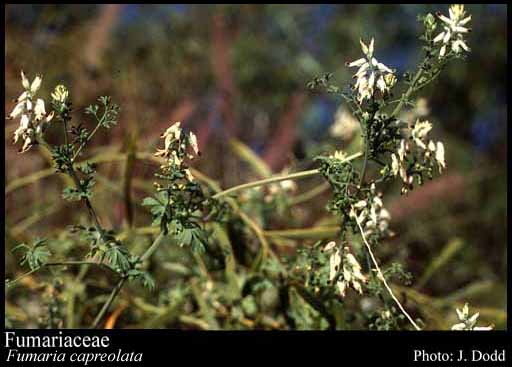
Scientific Description
Common name. Fumitory Family.
Habit and leaf form. Herbs, or herbaceous climbers. Perennial; plants with a basal concentration of leaves, or with neither basal nor terminal concentrations of leaves; rhizomatous, or tuberous. Climbing (sometimes scandent), or self supporting; when scandent, climbing via modified petiolules. Mesophytic. Leaves alternate (to sub-opposite); spiral; petiolate; non-sheathing; simple, or compound; when compound, ternate, or pinnate, or bipinnate, or multiply compound. Leaf blades when simple, usually dissected; when simple, pinnatifid, or palmately lobed, or much-divided; pinnately veined. Leaves without stipules; without a persistent basal meristem. Stem anatomy. Nodes unilacunar (usually), or tri-lacunar. Secondary thickening absent.
Reproductive type, pollination. Fertile flowers hermaphrodite. Unisexual flowers absent. Plants hermaphrodite.
Inflorescence and flower features. Flowers solitary (rarely), or aggregated in ‘inflorescences’ (usually); in racemes (usually). The terminal inflorescence unit cymose. Inflorescences ‘usually more or less racemose’. Flowers very irregular; zygomorphic; 2 merous; cyclic. Free hypanthium absent. Perianth with distinct calyx and corolla; 6; 3 -whorled; isomerous. Calyx 2; 1 -whorled; polysepalous; open in bud; not persistent (caducous, scalelike). Corolla 4; 2 -whorled; polypetalous to gamopetalous (more or less connivent, the two inner members more or less coherent over the stigmas apically); imbricate; spurred (or at least saccate, basally, in terms of one or both members of the outer whorl). Androecium 6. Androecial members free of the perianth; coherent; 2 - adelphous (i.e. in two bundles of three, the bundles opposite the outer corolla members). Androecium exclusively of fertile stamens. Stamens 6. Filaments appendiculate (with basal nectaries), or not appendiculate. Anthers extrorse; unilocular (the lateral members of each triplet), or bilocular (the central member — i.e. the stamens dimorphic within each triplet); bisporangiate and tetrasporangiate. Gynoecium 2 carpelled. The pistil 1 celled. Carpels isomerous with the perianth. Gynoecium syncarpous; eu-syncarpous; superior. Ovary unilocular; 1 locular. Gynoecium transverse; stylate. Styles 1; apical. Stigmas dorsal to the carpels, or dorsal to the carpels and commissural; capitate. Placentation parietal. Ovules in the single cavity 2–100 (to ‘many’); arillate; anatropous to campylotropous.
Fruit and seed features. Fruit non-fleshy; dehiscent (usually), or indehiscent (rarely), or lomentaceous; a capsule, or a silicula, or a siliqua, or a nut (rarely). Capsules loculicidal, or valvular (or breaking transversely into 1-seeded segments). Fruit 1–100 seeded. Seeds endospermic. Endosperm oily. Embryo well differentiated (small). Cotyledons 1 (e.g. some Corydalis spp.), or 2. Embryo achlorophyllous (2/2); straight to curved.
Geography, cytology, number of species. World distribution: widespread North temperate, a few in montane Southern and Eastern Africa. X = (6-)8. 450 species.