- Reference
- Anal.Fam.Pl. 59, 61 (1829)
- Name Status
- Current
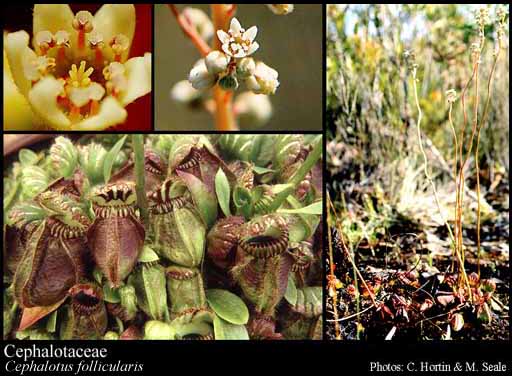
Scientific Description
Common name. Australian Pitcher-plant Family.
Habit and leaf form. Herbs. ‘Carnivorous’. Trapping mechanism passive. The traps consisting of ‘pitchers’. Perennial (rhizomatous); plants with a basal concentration of leaves. Helophytic to mesophytic (in the drier parts of peaty swamps). Conspicuously heterophyllous (the inner leaves flat and simple, the outer at ground level with blades modified as pitchers). Leaves medium-sized; alternate; spiral; petiolate (both types); non-sheathing; (those not modified as pitchers) simple; epulvinate. Leaf blades entire; cross-venulate. Leaves without stipules; without a persistent basal meristem.
Reproductive type, pollination. Fertile flowers hermaphrodite. Unisexual flowers absent. Plants hermaphrodite.
Inflorescence and flower features. Flowers aggregated in ‘inflorescences’. The terminal inflorescence unit cymose. Inflorescences scapiflorous; terminal; each consisting of a raceme of cymules. Flowers small; regular; 6 merous; cyclic; tetracyclic. Free hypanthium present. Hypogynous disk present (setose-glandular). Perianth sepaline; 6; 1 -whorled. Calyx 6; 1 -whorled; gamosepalous (basally); valvate; regular; persistent; accrescent. Corolla absent. Androecium 12. Androecial members perigynous; markedly unequal (the six alternating with the sepals longer); free of one another; 2 -whorled (the alternisepalous members being ‘slightly forward’). Androecium exclusively of fertile stamens. Stamens 12; diplostemonous. Anthers dorsifixed; versatile; dehiscing via longitudinal slits; strongly introrse; appendaged (int that the connective is apically swollen and glandular). Gynoecium 6 carpelled; apocarpous; eu-apocarpous to semicarpous (carpels free to basally united); superior. Carpel apically stigmatic; 1(–2) ovuled. Placentation basal. Ovules ascending; epitropous; with dorsal raphe; non-arillate; anatropous.
Fruit and seed features. Fruit non-fleshy; an aggregate. The fruiting carpel dehiscent; a follicle. Seeds endospermic. Endosperm oily. Embryo well differentiated. Cotyledons 2. Embryo straight.
Physiology, biochemistry. Aluminium accumulation not found.
Geography, cytology, number of species. World distribution: South Western Australia. X = 10. 1 species.