This name is not current. Find out more information on related names.
- Reference
- Prodr. 1:343 (1824)
- Name Status
- Not Current
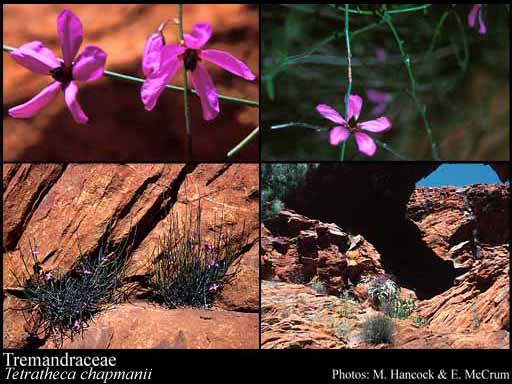
Scientific Description
Common name. Tremandra Family.
Habit and leaf form. Small shrubs, or herbs (slender subshrubs, or subherbaceous). ‘Normal’ plants, or switch-plants; sometimes with the principal photosynthesizing function transferred to stems. Leaves well developed, or much reduced, or absent. Perennial. Mesophytic, or xerophytic. Leaves minute, or small; alternate, or opposite, or whorled; ‘herbaceous’, or leathery, or membranous; imbricate (often), or not imbricate; petiolate to sessile; non-sheathing; simple. Leaf blades entire; flat, or rolled (often ericoid); one-veined, or pinnately veined; cross-venulate, or without cross-venules. Leaves without stipules (as usually interpreted, but often with glands in the stipular positions). Leaf blade margins entire, or dentate. Leaves without a persistent basal meristem. Stem anatomy. Nodes unilacunar. Secondary thickening developing from a conventional cambial ring.
Reproductive type, pollination. Fertile flowers hermaphrodite. Unisexual flowers absent. Plants hermaphrodite.
Inflorescence and flower features. Flowers solitary (axillary, slender-pedunculate), or aggregated in ‘inflorescences’; axillary. Inflorescences (when flowers grouped) axillary (with up to four flowers per axil). Flowers bracteate; small; regular; (3–)4 merous, or 5 merous; cyclic; tetracyclic (if the stamens are interpreted as one whorl). Free hypanthium absent. Hypogynous disk present, or absent. Perianth with distinct calyx and corolla; 6, or 8, or 10; 2 -whorled; isomerous. Calyx (3–)4–5; 1 -whorled; polysepalous (usually), or gamosepalous; valvate; regular; with the median member posterior. Corolla (3–)4–5; 1 -whorled; polypetalous; induplicate valvate; regular; white, or pink, or purple. Androecium 6 (rarely), or 8, or 10. Androecial members branched (this being a reasonable interpretation of the antepetalous pairs), or unbranched (as conventionally interpreted); free of the perianth; free of one another, or coherent; 4 - adelphous, or 5 - adelphous (interpreting the pairs as ‘bundles’). The androecial groups opposite the petals. Androecial members 1 -whorled (seemingly, though twice the corolla in number). Androecium exclusively of fertile stamens. Stamens 6 (rarely), or 8, or 10; diplostemonous; alternisepalous (in antepetalous pairs); all opposite the corolla members; erect in bud; filantherous (with short filaments). Anthers basifixed; non-versatile; dehiscing via pores (a single apical pore); four locular; tetrasporangiate; appendaged, or unappendaged. The anther appendages when present, apical. Gynoecium 2 carpelled. The pistil 2 celled. Carpels reduced in number relative to the perianth. Gynoecium syncarpous; eu-syncarpous; superior. Ovary plurilocular; 2 locular. Gynoecium median; stylate. Styles 1; apical. Placentation axile, or apical. Ovules 1–2(–5) per locule; pendulous; epitropous; with ventral raphe; arillate (usually), or non-arillate (Platytheca); anatropous.
Fruit and seed features. Fruit non-fleshy; dehiscent; a capsule. Capsules loculicidal, or septicidal and loculicidal. Seeds endospermic; winged (via a twisted appendage), or wingless. Cotyledons 2. Embryo straight. Seedling. Germination phanerocotylar.
Physiology, biochemistry. Aluminium accumulation not found.
Geography, cytology, number of species. World distribution: Australia. About 45 species.
Keys
Western Australian Genera and Families of Flowering Plants — an interactive key
T.D. Macfarlane, L. Watson, N.G. Marchant