This name is not current. Find out more information on related names.
- Reference
- Voy.Terra Austral. 2:555 (1814)
- Name Status
- Not Current
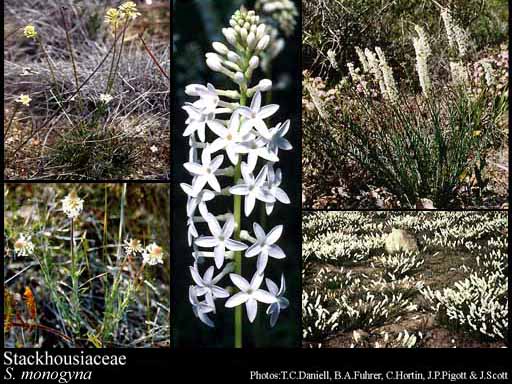
Scientific Description
Common name. Stackhousia Family.
Habit and leaf form. Herbs. ‘Normal’ plants, or switch-plants. Leaves well developed, or much reduced. Plants succulent, or non-succulent. Annual, or perennial; perennials rhizomatous. Mesophytic, or xerophytic. Leaves alternate; spiral; ‘herbaceous’, or leathery, or fleshy, or membranous; petiolate to sessile; non-sheathing; simple; epulvinate. Leaf blades entire; linear, or lanceolate, or oblanceolate; one-veined, or pinnately veined. Leaves inconspicuously with stipules. Stipules interpetiolar (or terete); scaly; caducous (usually), or persistent. Leaf blade margins entire. Stem anatomy. Secondary thickening developing from a conventional cambial ring.
Reproductive type, pollination. Fertile flowers hermaphrodite. Unisexual flowers absent. Plants hermaphrodite.
Inflorescence and flower features. Flowers solitary, or aggregated in ‘inflorescences’; in cymes, or in racemes, or in umbels. The terminal inflorescence unit cymose, or racemose. Inflorescences racemes or cymes, rarely umbellate. Flowers bracteate; bracteolate (usually, with two bracteoles), or ebracteolate; fragrant (usually), or odourless; regular to somewhat irregular. The floral asymmetry involving the androecium. Flowers 5 merous; cyclic; tetracyclic. Free hypanthium present. Hypogynous disk present (lining the floral tube). Perianth with distinct calyx and corolla; 10; 2 -whorled; isomerous. Calyx 5; 1 -whorled; polysepalous (on the hypanthium), or gamosepalous; entire, or lobed; imbricate; regular, or unequal but not bilabiate. Corolla 5; 1 -whorled; polypetalous, or gamopetalous; imbricate; unequal but not bilabiate, or regular; white, or yellow, or pink, or purple. Petals clawed (the claws free, even when gamopetalous above). Androecium 5. Androecial members free of the perianth; markedly unequal (usually three long, two short), or all equal (Macgregoria); free of one another; 1 -whorled. Androecium exclusively of fertile stamens. Stamens 5; isomerous with the perianth; oppositisepalous; all alternating with the corolla members. Anthers dehiscing via longitudinal slits; tetrasporangiate; appendaged (Macgregoria), or unappendaged. The anther appendages apical. Gynoecium (2–)3(–5) carpelled. The pistil (2–)3(–5) celled. Carpels reduced in number relative to the perianth to isomerous with the perianth. Gynoecium syncarpous; synovarious to synstylovarious; superior. Ovary plurilocular; (2–)3(–5) locular. Gynoecium stylate. Styles 1, or 2–5; free, or partially joined; attenuate from the ovary, or from a depression at the top of the ovary; apical. Stigmas 2–5. Placentation axile to basal. Ovules 1 per locule; ascending; apotropous; with ventral raphe; anatropous.
Fruit and seed features. Fruit non-fleshy; a schizocarp. Mericarps comprising nutlets, or samaroid. Fruit 2–5 seeded. Seeds endospermic. Endosperm oily. Cotyledons 2. Embryo straight. Seedling. Germination phanerocotylar.
Physiology, biochemistry. Aluminium accumulation not found.
Geography, cytology, number of species. World distribution: Malaysia, Australia, New Zealand. X = 9, 10, 15. 27 species.
Keys
Western Australian Genera and Families of Flowering Plants — an interactive key
T.D. Macfarlane, L. Watson, N.G. Marchant