This name is not current. Find out more information on related names.
- Reference
- Prodr.Fl.Nov.Holland. 514 (1810)
- Name Status
- Not Current
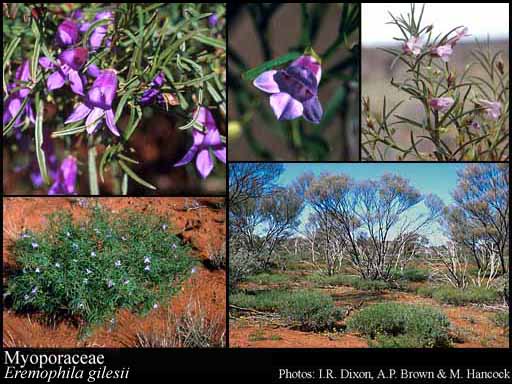
Scientific Description
Common name. Myoporum Family.
Habit and leaf form. Small trees, or shrubs; deciduous; resinous, or not resinous. Young stems cylindrical. Mesophytic, or xerophytic. Leaves minute to small (often), or medium-sized; alternate, or opposite (rarely), or whorled (rarely); usually spiral; often more or less leathery; petiolate to sessile; non-sheathing; gland-dotted (often), or not gland-dotted (Oftia); simple; epulvinate. Leaf blades entire. Leaves without stipules. Leaf blade margins entire, or crenate, or serrate, or dentate. Leaves without a persistent basal meristem. Stem anatomy. Nodes unilacunar. Secondary thickening developing from a conventional cambial ring.
Reproductive type, pollination. Fertile flowers hermaphrodite. Unisexual flowers absent. Plants hermaphrodite.
Inflorescence and flower features. Flowers solitary, or aggregated in ‘inflorescences’; in cymes. The terminal inflorescence unit cymose. Inflorescences axillary. Flowers ebracteate; small, or medium-sized; regular to very irregular; mostly more or less zygomorphic. The floral asymmetry involving the androecium, or involving the perianth and involving the androecium (not the calyx). Flowers 5 merous; cyclic; tetracyclic. Free hypanthium absent. Perianth with distinct calyx and corolla; (9–)10; 2 -whorled; isomerous, or anisomerous (rarely). Calyx (4–)5; 1 -whorled; more or less polysepalous, or gamosepalous; when gamosepalous, lobed; basally imbricate, or valvate, or open in bud; regular, or unequal but not bilabiate to bilabiate; persistent (scarious); accrescent (often), or non-accrescent; with the median member posterior. Corolla more or less disguisedly 5; 1 -whorled; gamopetalous; lobed. Corolla lobes markedly shorter than the tube to markedly longer than the tube. Corolla imbricate; bilabiate (often, more or less), or regular to unequal but not bilabiate. Androecium (3–)4(–5). Androecial members adnate (to the corolla tube); all equal, or markedly unequal (usually); free of one another; 1 -whorled. Androecium exclusively of fertile stamens (the upper, posterior member lacking), or including staminodes. Staminodes when present, 1; representing the posterior median member. Stamens (3–)4(–5); becoming exserted, or remaining included; when didynamous, i.e. usually, didynamous; reduced in number relative to the adjacent perianth (usually), or isomerous with the perianth; fertile stamens representing the posterior-lateral pair and the anterior-lateral pair; oppositisepalous; all alternating with the corolla members. Anthers connivent, or separate from one another; dorsifixed; versatile; dehiscing via longitudinal slits, or dehiscing transversely; introrse; unilocular (the cells confluent). Gynoecium 2 carpelled. The pistil 2 celled, or 3–10 celled (by secondary segmentation of the locules). Carpels reduced in number relative to the perianth. Gynoecium syncarpous; synstylovarious to eu-syncarpous; superior. Ovary plurilocular; 2 locular. Locules secondarily divided by ‘false septa’, or without ‘false septa’. Gynoecium median; stylate. Styles 1; from a depression at the top of the ovary; apical. Stigmas 1; 1–2 - lobed; dry type; papillate; Group II type. Placentation axile, or apical. Ovules (1–)2 per locule (from near the summit), or 4–8 per locule (superposed in pairs); pendulous; non-arillate; anatropous.
Fruit and seed features. Fruit fleshy to non-fleshy; indehiscent; a drupe. The drupes with separable pyrenes (othe segments one-seeded). Seeds scantily endospermic, or non-endospermic. Cotyledons 2. Embryo straight. Seedling. Germination phanerocotylar.
Physiology, biochemistry. Aluminium accumulation not found.
Special features. Calyx limb when gamosepalous, (4–)5 lobed. The upper lip of the corolla incorporating 2 members, the lower 3, or incorporating 4 members, the lower 1; (posterior, adaxial) lip of the corolla bilobed to 4 lobed. Lower (abaxial) lip of the corolla entire to 3 lobed.
Geography, cytology, number of species. World distribution: mainly Australasia and the South Pacific islands, a few in South Africa, Mauritius, Eastern Asia, Hawaii, West Indies. X = 27. 90 species.