- Reference
- Nuytsia 17:343-345, Fig. 7 (2007)
- Conservation Code
- Priority One
- Naturalised Status
- Native to Western Australia
- Name Status
- Current
Annual, herb, 0.03-0.04 m high. White or grey-brown sand over clay, yellow-brown gravelly clay and granite. Moist sheltered areas, near salt lakes.
Scientific Description
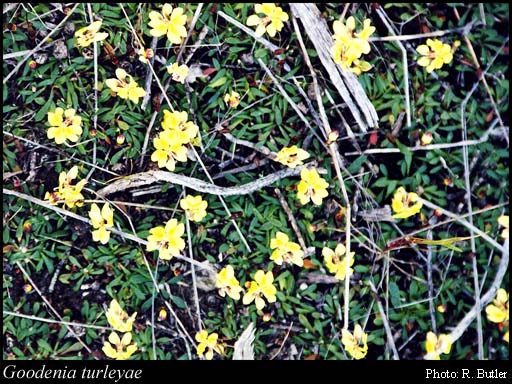
Stems unribbed. Leaves flat, 5-7 mm long, 2-3 mm wide, Indumentum absent (leaves glabrous); margins entire. Bracteoles absent. Pedicel pedicellate, Pedicel length the pedicels 10-12 mm long, glabrous. Calyx lobes present, Calyx length 2.5-3 mm long, glabrous. Corolla yellow, 8-10 mm long, auriculate, not spurred, glabrous on the outside, hairy on the inside; central lobes 2-3 mm long, with wings; outer lobes 4-5 mm long, wing present on both sides and clearly unequal, 0.3 mm wide on the narrower side, 1.5 mm wide on the broader side. Anthers free. Ovary inferior, not gibbose; style 2-3 mm long, hairy; indusium single, hairy; ovules more than two. Flowers in September, October and November. Occurs in the Mallee (MAL) IBRA Region(s), of the South West (SW) Botanical Province. Conservation Code: Conservation code Priority One (P1).
Distribution
- IBRA Regions
- Esperance Plains, Mallee.
- IBRA Subregions
- Eastern Mallee, Recherche.
- Local Government Areas (LGAs)
- Esperance.