
Service Notice

The Western Australian Herbarium’s collections management system, WAHerb, and DBCA’s flora taxonomic names application, WACensus, have been set to read-only mode since 1 October 2025. Recent taxonomic changes are not currently being reflected in Florabase, herbarium collections, or the census. The Herbarium team, working with the Biodiversity Information Office, now have the Nomos-hosted WACensus in production, and we will begin to update the flora and fungi for WA within the system soon. The Specify project team continues to test and streamline the new collections management system, and we expect this to be online in October. Please reach out to us if you have any questions or concerns.

The notice period started at 9:45 am on Friday, 12 December 2025 +08:00 and will end at 12:00 pm on Thursday, 1 October 2026 +08:00.

Eremophila tietkensii F.Muell. & Tate

Reference
Trans.Proc.& Rep.Roy.Soc.South Australia 13:109 (1890)
Conservation Code
Not threatened
Naturalised Status
Native to Western Australia
Name Status
Current

Spreading shrub, to 2 m high. Fl. white/blue/purple, Apr to Sep. Red sand, red to brown silty loam, red-brown skeletal loam over ironstone, gravel, laterite, dolerite, limestone. Undulating shaley clay plains, flats, plateaus, gully slopes, rocky sites: hills, creeklines, scree slopes, outcrops.
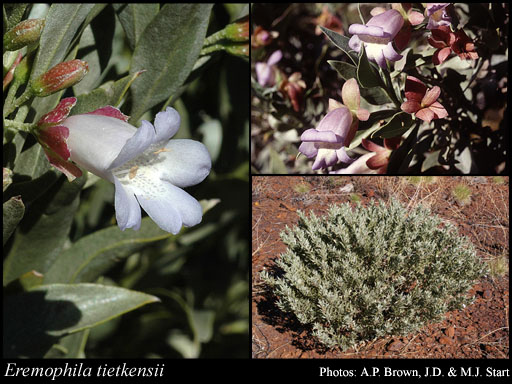
Amanda Spooner, Descriptive Catalogue, 6 February 2006
Image

Distribution

IBRA Regions
Carnarvon, Central Ranges, Gascoyne, Gibson Desert, Great Sandy Desert, Little Sandy Desert, Murchison, Pilbara.
IBRA Subregions
Augustus, Cape Range, Chichester, Hamersley, Lateritic Plain, Mackay, Mann-Musgrave Block, Rudall, Trainor, Western Murchison, Wooramel.
Local Government Areas (LGAs)
Ashburton, Carnarvon, East Pilbara, Exmouth, Meekatharra, Murchison, Ngaanyatjarraku, Upper Gascoyne.