- Reference
- Bot.Tidsskr. 30:201 (1910)
- Conservation Code
- Not threatened
- Naturalised Status
- Alien to Western Australia
- Name Status
- Current
Scientific Description
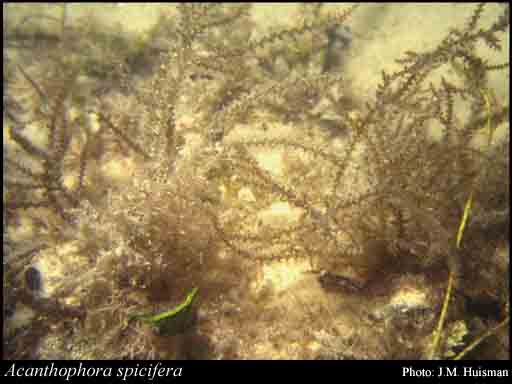
Habit and structure. Thallus erect, to 6 cm tall, with percurrent to irregularly branched terete axes bearing spirally arranged short determinate branches, these with numerous short spines, mostly near apices. Spines rare to absent on primary axes. Trichoblasts associated with branch apices and primordia, dichotomously branched, to 1.6 mm long, with lower cells 15–25 µm diam. [L:B c. 2–3], distally tapering to elongate cells 5–8 µm diam. [L:B to 25]. Structure uniaxial, with 5 (rarely 6) pericentral cells, these pit-connected at the distal end of slender axial cells, often with a space between the axial filament and pericentral cells. Rhizoidal filaments occasionally filling the intercellular spaces. Pericentral cells 150–300 µm diam., 900–1000 µm long (of equal length to bearing axial cell), surrounded by several layers of cells of similar diameter but shorter, then progressively smaller cells. Cortex of 1 or 2 layers of pigmented cells, the outer layer of longitudinally elongate cells, 8–20 µm diam. [L:B 2–10].
Reproduction. Tetrasporangia borne near branch apices, ellipsoidal to obovoid, 60–100 µm long, 45–75 µm wide, tetrahedrally divided.
Distribution. Widely distributed in tropical waters
Habitat. Epilithic in the intertidal and shallow subtidal.
[After J.M. Huisman in Algae of Australia: Marine Benthic Algae of North-western Australia, 2. Red Algae: 482 (2018)]
Distribution
- IBRA Regions
- Carnarvon, Dampierland, Indian Tropical Islands, Northern Kimberley, Pilbara, Swan Coastal Plain.
- IBRA Subregions
- Cape Range, Mitchell, Perth, Pindanland, Roebourne, Wooramel.
- IMCRA Regions
- Abrolhos Islands, Cambridge-Bonaparte, Canning, Central West Coast, Kimberley, Ningaloo, Pilbara (nearshore), Pilbara (offshore), Shark Bay.
- Local Government Areas (LGAs)
- Ashburton, Broome, Carnarvon, Cocos Islands, Exmouth, Greater Geraldton, Irwin, Karratha, Mandurah, Port Hedland, Shark Bay, Wyndham-East Kimberley.