- Reference
- Austral.J.Bot. 99 (1964)
- Conservation Code
- Not threatened
- Naturalised Status
- Native to Western Australia
- Name Status
- Current
Scientific Description
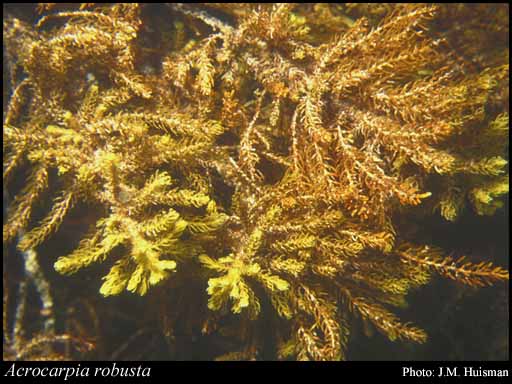
Habit and structure. Thallus dark brown, 10–35(–45) cm long, with one to several primary branches from the holdfast, bushy above. Holdfast 0.5–2.5 cm across, conical, lacerate with short subdichotomous haptera in older plants; epilithic. Primary branches 10–25 cm long, 1–3 mm thick until near the apices, terete, straight, with tristichously arranged laterals and occasional secondary axes arising adaxially from young laterals, denuded below, with pointed branch residues 0.5–2 mm long. Laterals dense, 1–2 mm apart, 1–4(–6) cm long, with tristichously and spirally arranged ramuli 0.5–1 mm apart; ramuli once bifurcate near their base, 1–3(–4) mm long, 200–350 µmin diameter. Central medulla of elongate cells with abundant hyphae and a cortex of isodiametric cells with a surface meristoderm.
Reproduction. Receptacles developed from ends of upper ramuli, 2–5 mm long, 400–600 µm in diameter, pedicellate, torulose (especially when dried). Conceptacles crowded, bisexual, with a prominent basal columella bearing phaeophycean hairs, ostioles scattered; oogonia sessile, ovoid, 100–200 µm long and 80–l50 µm in diameter; antheridia sessile or on branched paraphyses, elongate-ovoid, 25–40 µm long and 7–10 µm in diameter.
Distribution. From Cape Naturaliste to Israelite Bay, W. Aust.
Habitat. A. robusta is often common in the uppermost sublittoral on granite rocks.
[After Womersley, Mar. Benthic Fl. Southern Australia II: 364 (1987)]
Distribution
- IBRA Regions
- Jarrah Forest, Warren.
- IBRA Subregions
- Southern Jarrah Forest, Warren.
- IMCRA Regions
- Leeuwin-Naturaliste, WA South Coast.
- Local Government Areas (LGAs)
- Albany, Augusta Margaret River, Busselton, Esperance, Manjimup.