- Reference
- Trans.Roy.Irish Acad. 22(1):547 (1855)
- Conservation Code
- Not threatened
- Naturalised Status
- Native to Western Australia
- Name Status
- Current
Scientific Description
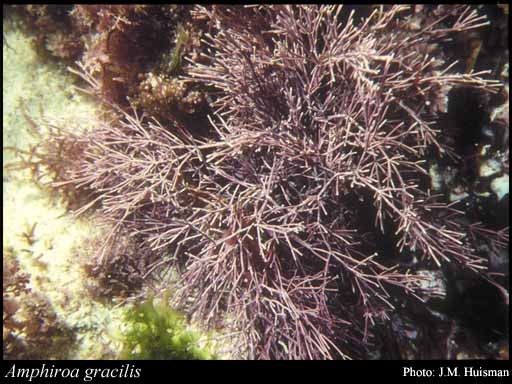
Habit and structure. Thallus medium red-brown, fading to grey-red, 4–10 cm high, with several axes from the holdfast, branching usually fastigiate with 2–4(–6) branches from each intergeniculum, not complanate, intergenicula terete, 4–6 mm long and (1–)1.5–2 mm in diameter near the base, decreasing evenly to (3–)4–6 mm long and 300–500 µm in diameter above. Holdfasts crustose, 2–8 mm across, bearing several to numerous fronds; epilithic. Structure multiaxial. Intergenicula of numerous arching tiers of medullary cells, with lateral pit-connections about three-quarters up the cells; single tiers of shorter cells (15–45 µm long) separating every 2–4(–7) tiers of longer cells (60–90 µm long), all 9–16 µm in diameter, ends rounded. Genicula ends not corresponding to tiers, similar in structure to intergenicula but cells narrower, thicker walled and darkly staining, with lateral pit-connections. Cortex compact, developed from larger, ovoid, outer medullary cells, consisting of anticlinal filaments of 5–10 ovoid cells (6–)7–9 µm in diameter, with short epithallial cells, present but less well developed on genicula. Apices of branches with meristematic cells and small epithallial cells. Rhodoplasts discoid to laminate.
Reproduction. Gametangial thalli unknown. Tetrasporangial conceptacles prominent, 250–500 µm in external diameter, tetrasporangia among elongate cells, 70–110 µm long and 35–55 µmin diameter, zonately divided.
Distribution.Kalbarri, W. Aust., to Troubridge Hill, Yorke Pen, S. Aust.
[After Womersley, Mar. Benthic Fl. Southern Australia IIIB: 286–288 (1996)]
Distribution
- IBRA Regions
- Geraldton Sandplains, Jarrah Forest, Swan Coastal Plain.
- IBRA Subregions
- Geraldton Hills, Perth, Southern Jarrah Forest.
- IMCRA Regions
- Central West Coast, Kimberley, Leeuwin-Naturaliste.
- Local Government Areas (LGAs)
- Broome, Busselton, Cockburn, Coorow, Cottesloe, Dandaragan, Irwin, Mandurah, Northampton, Rockingham, Stirling.