- Reference
- Ann.Mag.Nat.Hist. 335 (1855)
- Conservation Code
- Not threatened
- Naturalised Status
- Native to Western Australia
- Name Status
- Current
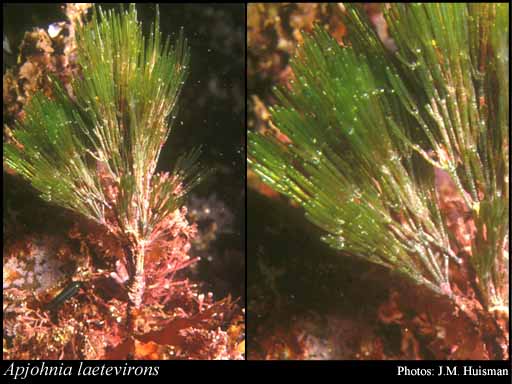
Scientific Description
Habit and structure. Thallus to 25 cm high, dendroid, with a single (or often clustered) stipitate basal segment 1–6 cm long and 1–4 mm in diameter attached by branched, sparsely septate rhizoids, and producing at its apex a row of 2–5 branches often lying in one plane or an irregular cluster or whorl of 3–9 elongate, linear or slightly expanded upwards, segments 0.5–2 cm long and 0.5–1.5(–2) mm in diameter. This pattern is repeated two to several times with the subterminal segments producing usually three and later five segments, the central one being produced first, followed by more-or-less equally developed lateral branches. Segments with prominent annular constrictions confined to the lower quarter to half on upper segments but sometimes extending over the lower half to three quarters (or even more) of lower segments; segments with complete end walls, vacuolar acicular calcium oxalate crystals present; bases of older segments often cutting off 2–8 small hapteroid cells which come to lie between the segments and extend rhizoidal processes downward and largely within the wall of the lower segment; cell wall lamellate, tough, 10–20 µm thick in younger segments, up to 50 µm thick below; chloroplasts discoid, closely packed, each with a prominent pyrenoid.
Reproduction. Biflagellate zooids liberated through lateral pores following reticulation of the protoplasm.
Distribution. From Green Head, W. Aust., around southern Australia to Collaroy, N.S.W. Deal and King I., Bass Str.
Habitat. A. laetevirens is often common in deep, shaded pools on rock platforms, and recorded to 16 m deep.
[After Womersley, Mar. Benthic Fl. Southern Australia I: 182 (1984)]
Distribution
- IBRA Regions
- Swan Coastal Plain, Warren.
- IBRA Subregions
- Perth, Warren.
- IMCRA Regions
- Abrolhos Islands, Central West Coast, Leeuwin-Naturaliste.
- Local Government Areas (LGAs)
- Augusta Margaret River, Busselton, Cockburn, Coorow, Greater Geraldton, Manjimup, Wanneroo.