- Reference
- Nomencl.Alg. 45 (1845)
- Conservation Code
- Not threatened
- Naturalised Status
- Native to Western Australia
- Name Status
- Current
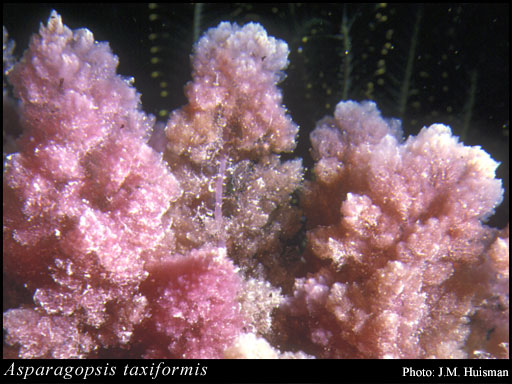
Red marine subtidal alga, epilithic, to 30 cm tall; base stoloniferous; upright axes percurrent, densely covered with radially branched determinate laterals. Structure uniaxial with three periaxial cells, primary axes corticated, otherwise uncorticated.
Scientific Description
Habit and structure. Thallus (gametophyte) mid to dark brown-red, fading to grey-red, 10–30 cm high, with long, plumose, main branches covered with densely and irregularly radially branched laterals mostly 1–2 cm long with crowded determinate ramuli 0.5–1(–1.5) mm long when mature and 35–65(–90) µm in basal diameter, tapering gradually; spinous branches absent. Attachment by basal stolons and rhizoids; usually epilithic. Structure uniaxial, with development of indeterminate branches and determinate ramuli as in A. armata. Cortex and axial filament also similar but slightly slenderer; axial filament 20–30 µm in diameter with swollen ends 70–90 µm in diameter, inner cortical cells ovoid and 20–30 µm in diameter, outer cortical cells angular and 9–14 µm across. Structure of ramuli as in A. armata, mature half-length cells 20–30 µm across. Rhodoplasts discoid, in chains in inner cells.
Reproduction. Gametangial thalli monoecious, with spermatangial heads nearer the branch apices than the cystocarps. Carposporophyte with a basal fusion cell and much branched gonimoblast filaments bearing terminal clavate carposporangia. Cystocarps borne on stalks 9–11 axial cells long, globular, 1–1.5 mm in diameter, pericarp 3–4 cells thick, ostiolate. Spermatangial heads broadly clavate, 180–280 µm in diameter and 350–650 µm long, with spermatangia cut off as a dense surface layer. Tetrasporophyte apparently indistinguishable from that of A. armata.
Distribution.Northern Australia to Rottnest I., W. Aust., and southern Qld; Lord Howe I. The Gulf Region of S. Aust. Tropical/subtropical oceans generally.
[After Womersley, Mar. Benthic Fl. Southern Australia IIIB: 331 (1996)]
Distribution
- IBRA Regions
- Carnarvon, Dampierland, Geraldton Sandplains, Indian Tropical Islands, Pilbara, Swan Coastal Plain, Yalgoo.
- IBRA Subregions
- Cape Range, Edel, Geraldton Hills, Perth, Pindanland, Roebourne, Wooramel.
- IMCRA Regions
- Abrolhos Islands, Canning, Central West Coast, Kimberley, Leeuwin-Naturaliste, Ningaloo, Pilbara (nearshore), Pilbara (offshore), Zuytdorp.
- Local Government Areas (LGAs)
- Ashburton, Augusta Margaret River, Broome, Carnarvon, Cockburn, Cocos Islands, Cottesloe, Dandaragan, Derby-West Kimberley, Exmouth, Greater Geraldton, Irwin, Karratha, Northampton, Port Hedland, Rockingham, Shark Bay, Wanneroo, Wyndham-East Kimberley.