- Reference
- Taxon 143 (1957)
- Conservation Code
- Not threatened
- Naturalised Status
- Native to Western Australia
- Name Status
- Current
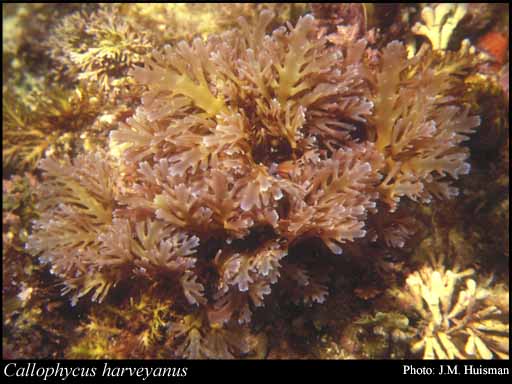
Scientific Description
Habit and structure. Thallus dark red-brown, 10–40 cm high, complanately branched with one to several main branches (2–)3–5 mm broad from a short stipe, branches compressed, without a midrib, bearing slightly narrower, subopposite, distichous pinnae which are mostly basally constricted and irregular in length, often developing into longer branches; pinnules compressed, usually simple, 0.5–2 cm long and 1–3 mm broad, margin entire. Holdfast discoid, 5–10 mm across, with a single stipe; epilithic. Structure multiaxial, with a core of medullary filaments and rhizoids and a pseudoparenchymatous cortex 5–8 cells thick, inner cells ovoid, 15–25 µm in diameter, and outer cells 3–5 µm in diameter. Rhodoplasts discoid, several per cell.
Reproduction.Sexual reproduction non-procarpic. Carpogonial branches 3(–4 )-celled, borne on an inner cortical cell with the basal cell often bearing 1–2 sterile cells or short chains, projecting inwards with a reflexed trichogyne. Connecting filaments several, unbranched and non-septate. Auxiliary cell and adjacent inner cortical cells becoming darker staining after diploidization and producing branches of small cells; gonimoblast initials first produced inwardly, later radially from the fusion cell (which has an enlarged axial filament), with terminal chains of ovoid carposporangia 6–10 µm in diameter. Cystocarps subterminal to midway long the pinnules, often crowded, hemispherical and protruding, with slight enveloping tissue, ostiolate. Spermatangia unknown. Tetrasporangia unknown.
Distribution.Port Denison, W. Aust., to 16 km E of Eucla, S. Aust.
[After Womersley, Mar. Benthic Fl. Southern Australia IIIA: 337–339 (1994)]
Distribution
- IBRA Regions
- Esperance Plains, Jarrah Forest, Swan Coastal Plain, Warren.
- IBRA Subregions
- Perth, Recherche, Southern Jarrah Forest, Warren.
- IMCRA Regions
- Abrolhos Islands, Central West Coast, Leeuwin-Naturaliste, WA South Coast.
- Local Government Areas (LGAs)
- Albany, Augusta Margaret River, Busselton, Cockburn, Coorow, Dandaragan, Esperance, Greater Geraldton, Irwin, Mandurah, Manjimup, Rockingham, Wanneroo.