- Reference
- Syll.Alg. 1605 (1905)
- Conservation Code
- Not threatened
- Naturalised Status
- Native to Western Australia
- Name Status
- Current
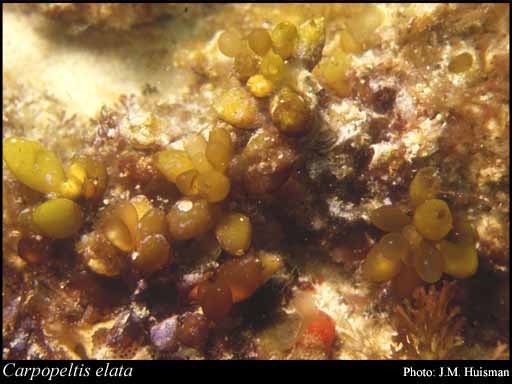
Scientific Description
Habit and structure. Thallus dark red-brown, 10–30(–80) cm high, cartilaginous, complanately and alternately branched, becoming denuded below and thickened, often slightly flexuous, with one to several axes. Holdfast discoid, 2–8 mm across; epilithic. Axes and main branches compressed, 1.5–2 mm broad, 200–400 µm thick, decreasing slightly to 0.5–1 mm broad near the rounded apices, axils rounded. Structure of a compact, pseudoparenchymatous cortex 6–12 cells thick, outer cells 2–4 µm across and slightly elongate in section, inner cells increasing in size to 15–30 µm across, subspherical to ovoid, stellate cells absent. Medulla relatively thin (0.3 to 0.1 of thallus thickness), of densely entwined filaments, refractive ganglionic cells absent. Rhodoplasts discoid, several to many per cell.
Reproduction. Sexual thalli probably monoecious, with sexual organs in sori in branch ends, arising in mid cortex. Carpogonial branch ampullae with a few (1–3) secondary filaments and a 2-celled carpogonial branch. Auxiliary cell ampullae larger, with several long secondary and tertiary filaments, converging above and reaching almost to the surface. Carposporophytes clustered in thickened (400–700 µm) branch ends, 120–160 µm across, with moderate involucres derived from the ampullary filaments and inner cortical cells, and small ostioles. Spermatangia cut off from surface cells, 2–3 µm across, spermatia subspherical, 1–2 µm across. Tetrasporangia in slightly raised nemathecia near branch ends, among paraphyses 2–3 cells long and 2–3 µm in diameter, 25–30 µm long and 8–12 µm in diameter, cruciately divided.
Distribution. Geraldton to the Recherche Arch., W. Aust.
[After Womersley, Mar. Benthic Fl. Southern Australia IIIA: 170–172 (1994)]
Distribution
- IBRA Regions
- Jarrah Forest, Swan Coastal Plain, Warren.
- IBRA Subregions
- Perth, Southern Jarrah Forest, Warren.
- IMCRA Regions
- Central West Coast, Leeuwin-Naturaliste, WA South Coast.
- Local Government Areas (LGAs)
- Albany, Augusta Margaret River, Busselton, Cockburn, Esperance, Irwin, Mandurah, Manjimup, Rockingham.