- Reference
- Phycologia 37:10-12, Figs 1-2 (1998)
- Conservation Code
- Not threatened
- Naturalised Status
- Native to Western Australia
- Name Status
- Current
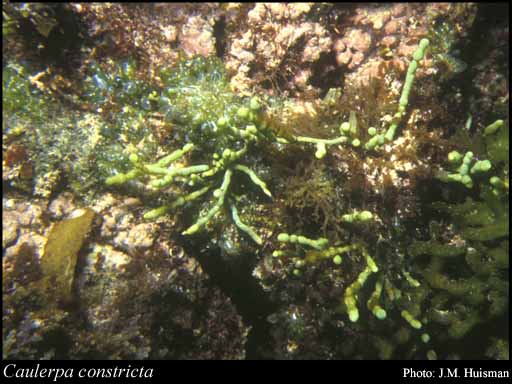
Scientific Description
Habit and structure. Thallus green to yellowish olive, spreading laterally to 25–30 cm, with smooth terete stolons 1–2 mm diam., and with infrequent articulations. Assimilators to 7 cm tall, terete, with basal and, rarely, intercalary articulations, often simple but occasionally branched, lacking differentiated ramuli. Branch tips obtuse.
Distribution. Endemic to W.A., where it is known from the Dampier Archipelago south to the Houtman Abrolhos Islands.
Habitat. Epilithic in the shallow subtidal.
[After Belton, Huisman & Gurgel, Algae of Australia: Mar. Benthic Algae of North-western Australia, 1. Green and Brown Algae 82 (2015)]
Distribution
- IMCRA Regions
- Abrolhos Islands, Ningaloo, Pilbara (nearshore), Pilbara (offshore).
- Local Government Areas (LGAs)
- Ashburton, Exmouth, Greater Geraldton, Karratha.