- Reference
- Spec.Alg. 437 (1820)
- Conservation Code
- Not threatened
- Naturalised Status
- Native to Western Australia
- Name Status
- Current
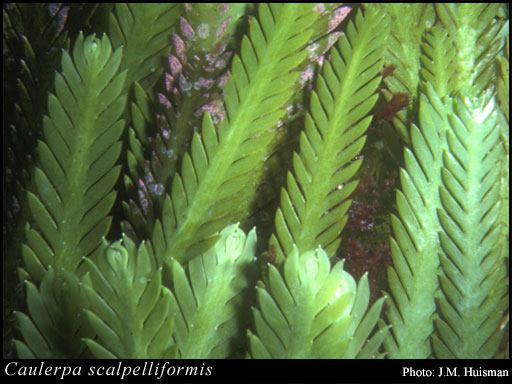
Green marine alga, epilithic, to 20 cm tall; base stoloniferous, terete, naked; upright fronds to 3 cm broad, terete below, otherwise flattened; lateral ramuli alternate-distichous, to 1.5 cm long, upwardly curved, tapering to a spinous tip.
Scientific Description
Habit and structure. Stolon slender (0.5–1 mm in diameter) in small forms of young plants, robust [(–3) mm in diameter] in large, rough-water plants, cartilaginous, naked, epilithic. Erect fronds medium to dark green, simple to occasionally branched, from 4–10 cm high and 3–6 mm broad in slender forms, to 20 cm high and 2(–3) cm broad in robust plants, terete for the basal 1–3 cm, then strongly compressed with an axis 2–3 mm broad in slender plants to 4–8(–10) mm broad in robust plants, bearing alternately distichous, closely adjacent ramuli. Ramuli 2–4 mm long and 1–2 mm broad in slender plants, to 1–1.5 cm long and 3–5 mm broad in robust plants, strongly compressed, scalpelliform, basally broadest but often slightly constricted, usually slightly upwardly curved and with an acute angle between adjacent ramuli, tapering gradually over their lower half to three quarters, then abruptly to a distinct spinous tip.
Distribution. From Whitfords Beach, Perth, W. Aust., around southern Australia (and Tas.) to Jervis Bay, N.S.W.
Habitat. Common in rock pools and to 36 m deep on rough-water coasts.
[After Womersley, Mar. Benthic Fl. Southern Australia I: 258 (1984)]
Distribution
- IBRA Regions
- Avon Wheatbelt, Esperance Plains, Swan Coastal Plain, Warren.
- IBRA Subregions
- Merredin, Perth, Recherche, Warren.
- IMCRA Regions
- Abrolhos Islands, Central West Coast, Leeuwin-Naturaliste, WA South Coast.
- Local Government Areas (LGAs)
- Augusta Margaret River, Busselton, Capel, Cockburn, Cottesloe, Esperance, Greater Geraldton, Irwin, Joondalup, Manjimup, Morawa, Rockingham.