- Reference
- Bot.Zeit. 49 (1845)
- Conservation Code
- Not threatened
- Naturalised Status
- Native to Western Australia
- Name Status
- Current
Scientific Description
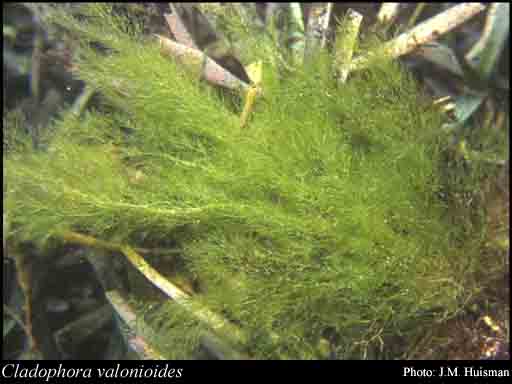
Habit and structure. Thallus light to medium green, 3–18(–25) cm high, singly or as clustered tufts of several plants, attached by rhizoids from the basal and adjacent cells; epilithic or epiphytic; filaments tapering only slightly, much branched above from almost every cell, forming fastigiate to spreading tufts, filaments straight or slightly incurved. Growth acropetal and mainly apical above, with intercalary divisions in lower cells thus separating the lower laterals by 2–6 cells; laterals first arising 1–3 cells from apex, ultimately with each parent cell bearing 1–3(–4) laterals of varying length, often to some extent unilaterally arranged and at acute to 45° angles. Cross walls arising and remaining oblique to parent cell, or later becoming almost horizontal. Apical cells 170–300 µm in diameter, L/B 2–7, cylindrical with rounded ends; ultimate branch cells 170–280 µm in diameter, L/B 2–6; basal cells 300–365 µm in maximum diameter, L/B 2.5–14; ratio of lower cell to apical cell diameters 1–2; walls moderately thick, (4–)6–8 µm in apical cells, 20–30 µm in mid thallus and 40–80 µm in lower cells, lamellate.
Reproduction. By apical or sub-apical cells developing into slightly swollen or clavate zooidangia.
Distribution. From Champion Bay, W. Aust., to Guichen Bay, S. Aust.
Habitat. On rough-water rock platforms and extending to 25 m deep.
[After van den Hoek & Womersley in Womersley, Mar. Benthic Fl. Southern Australia I: 196–198 (1984)]
Distribution
- IBRA Regions
- Esperance Plains, Swan Coastal Plain.
- IBRA Subregions
- Perth, Recherche.
- IMCRA Regions
- Central West Coast, Leeuwin-Naturaliste.
- Local Government Areas (LGAs)
- Augusta Margaret River, Cockburn, Coorow, Cottesloe, Dandaragan, Esperance, Fremantle, Irwin, Mandurah, Rockingham.