- Reference
- Syn.Alg.Scand. xxvi (1817)
- Conservation Code
- Not threatened
- Naturalised Status
- Native to Western Australia
- Name Status
- Current
Scientific Description
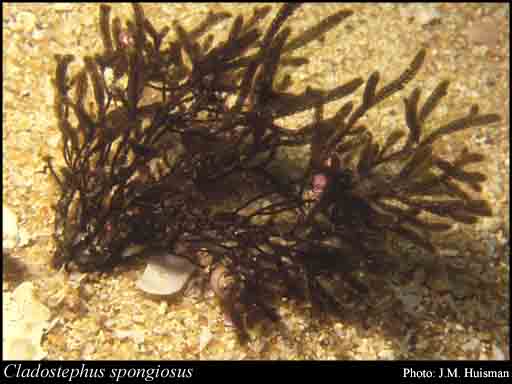
Habit and structure. Thallus medium brown, 5–20 cm long, with one to several repeatedly subdichotomous, linear axes 1–3 mm in diameter, from the crustose base, epilithic (rarely epiphytic). Branching of axes usually at moderate to long intervals, sometimes at short intervals, bearing closely packed and indistinct whorls of determinate laterals in shallow-water plants or distinct whorls in deeper-water plants; axes heavily corticated, denuded below, 300–500 µm in diameter. Determinate laterals usually upwardly curved, ecorticate, at first simple but developing 1 to 3 laterals, often with axillary phaeophycean hairs, branched acroblastically, (500–)600–1000 µm long, tapering basally and apically and 40–60 µm in diameter.
Reproduction. Sporangia and gametangia borne on more or less straight and densely clustered ecorticate, usually simple, laterals 400–600 µm long and 18–24(–30) µm in diameter with segments L/B 0.2–0.6(–1.0), developed from outer cortical cells of older and mid parts of axes (mainly in winter), at first arising between the determinate laterals. Unilocular sporangia (not observed on Australian plants) with a 1–3 celled pedicel, ovoid, 55–80 µm long and 35–55 µm in diameter; plurilocular gametangia with a 1–6 celled pedicel, in groups of 1–3, ovoid to elongate ovoid, (25–)30–60 µm long and 20–30 µm in diameter, with loculi 3–4 µm across.
Distribution. In Australia, from Yanchep, W. Aust., around southern Australia and Tas., to Keppel Bay, Qld. Fertile from April to November.
[After Womersley, Mar. Benthic Fl. Southern Australia II: 185–187 (1987)]
Distribution
- IBRA Regions
- Jarrah Forest, Swan Coastal Plain, Warren.
- IBRA Subregions
- Perth, Southern Jarrah Forest, Warren.
- IMCRA Regions
- Central West Coast, Leeuwin-Naturaliste, WA South Coast.
- Local Government Areas (LGAs)
- Albany, Augusta Margaret River, Busselton, Capel, Cockburn, Cottesloe, Fremantle, Manjimup, Rockingham, Wanneroo.