- Reference
- Acta Univ.Lund. ser. 2, 27(11):15 (1931)
- Conservation Code
- Not threatened
- Naturalised Status
- Native to Western Australia
- Name Status
- Current
Scientific Description
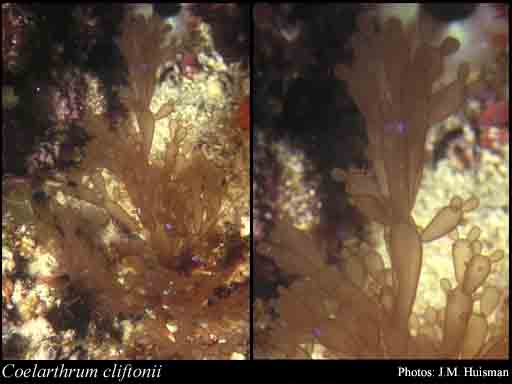
Habit and structure. Thallus mediumred to red-brown, fading to yellow-red, 5–20 cm high, much branched radially to 3 or 4 orders, with percurrent main axes or branches, laterals and lesser branches progressively shorter. All branches segmented, branches arising irregularly from the upper half of each segment, with occasional anastomoses, segments hollow, elongate ovoid, increasing in size from the branch apices, 1–3(–4) cm long and 3–6 mm in diameter near the thallus base; constrictions very short in length and 0.5–1.5 mm broad. Holdfast discoid, epilithic or on solid substrata. Structure multiaxial, with a cortex 20–30 µm and 1–2 cells thick, outer cells laxly arranged, often in slight rosettes, ovoid and 4–6 µm in diameter, changing abruptly to a large-celled medulla 1–2 cells thick bordering the central weakly mucilaginous cavity, with the inner cells ovoid and 90–250 µm in diameter, walls 3–8 µm thick with some secondary pit-connections and bearing branched filaments from initials on the inner medullary cells which cut off ovoid secretory cells 7–14 µm in diameter. Rhodoplasts discoid, in chains in inner cells. Constrictions with partitions one cell thick, with occasional smaller cells between the larger ones and with slender branched filaments bearing secretory cells on both sides.
Reproduction. Gametangial thalli dioecious. Carpogonial branches 4-celled, arising on mid cortical supporting cells with an attached cortical cell producing the auxiliary cell. Carposporophytes with a basal fusion cell and a subspherical mass of carposporangia each 15–20 µm in diameter. Basal nutritive tissue slight, with non-persistent erect filaments. Cystocarps scattered, 700–800 µm across, protruding mainly inwardly, with a thickened pericarp, ostiolate. Spermatangia cut off from laterally proliferating surface cortical cells, ovoid, 2–3 µm in diameter. Tetrasporangia scattered, transformed from inner cortical intercalary cells, ovoid, 18–30 µm in diameter, decussately divided.
Distribution.Montebello Is., W. Aust., to Troubridge I., S. Aust., and Vivonne Bay, Kangaroo I., S. Aust.
[After Womersley, Mar. Benthic Fl. Southern Australia IIIB: 57–59 (1996)]
Distribution
- IBRA Regions
- Carnarvon, Geraldton Sandplains.
- IBRA Subregions
- Cape Range, Geraldton Hills.
- IMCRA Regions
- Abrolhos Islands, Central West Coast, Leeuwin-Naturaliste, Pilbara (nearshore), Pilbara (offshore), WA South Coast.
- Local Government Areas (LGAs)
- Ashburton, Cockburn, Esperance, Greater Geraldton, Karratha, Wanneroo.