- Reference
- J.Phycol. 246 (1982)
- Conservation Code
- Not threatened
- Naturalised Status
- Native to Western Australia
- Name Status
- Current
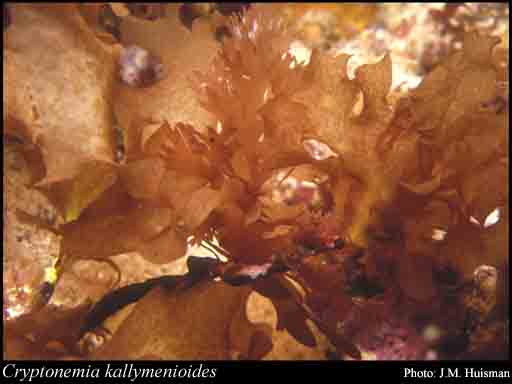
Scientific Description
Habit and structure. Thallus medium red-brown, with a perennial, branched, basal stalk, becoming relatively massive and showing growth rings in older parts, (2–)5–15 cm high and 4–10(–20) mm thick, compressed above, bearing 1–5 fronds from the apex of each branch. Fronds probably seasonal, expanding rapidly from the stalk apices, 5–26 cm long and 5–30 cm broad, 120–300 µm thick, complanate, foliose and variously branched with the margin usually becoming deeply indented and lobed, with the surface conspicuously mottled. Holdfast 2–10(–30) mm across; epilithic. Structure of a relatively thin cortex 2–5 cells thick, outer cells 3–5 µm across and slightly elongate in section, with ovoid inner cells (becoming separated and slightly stellate), and a lax filamentous medulla of transverse and irregular filaments 2–4 µm in diameter, becoming moderately dense in older parts and with numerous prominent refractive ganglionic cells. Rhodoplasts discoid to elongate, several per cell.
Reproduction. Carpogonial branch ampullae not seen. Auxiliary cell ampullae in the inner cortex, subspherical, with numerous fairly long secondary filaments forming a prominent ampulla, converging above. Carposporophyte with a persistent basal auxiliary cell and 2–3 lobes of carposporangia, with a slight ampullary involucre and small ostiole. Spermatangia unknown. Tetrasporangia scattered, cut off from outer cortical cells which divide to form irregular rows of 1–3 cells surrounding the sporangia, 16–25 µm long and 10–16 µm in diameter, cruciately divided.
Distribution.Geraldton to Hamelin Bay, W. Aust., and Cannan Reefs, S. Aust.
[After Womersley, Mar. Benthic Fl. Southern Australia IIIA: 184–185 (1994)]
Distribution
- IBRA Regions
- Esperance Plains, Geraldton Sandplains, Swan Coastal Plain.
- IBRA Subregions
- Geraldton Hills, Perth, Recherche.
- IMCRA Regions
- Abrolhos Islands, Central West Coast, Leeuwin-Naturaliste, Pilbara (nearshore), Shark Bay, WA South Coast.
- Local Government Areas (LGAs)
- Cockburn, Dandaragan, Esperance, Greater Geraldton, Irwin, Joondalup, Karratha, Mandurah, Rockingham, Shark Bay.