- Reference
- Acta Univ.Lund. 28:61 (1932)
- Conservation Code
- Not threatened
- Naturalised Status
- Native to Western Australia
- Name Status
- Current
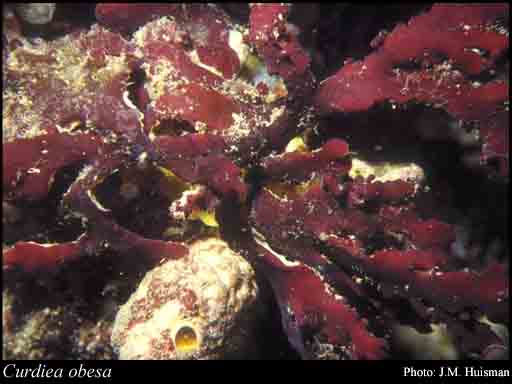
Scientific Description
Habit and structure. Thallus dark red-brown, decumbent but free of the substrate above the hold fast, 5–10(–15) cm long, cartilaginous, more-or-less complanately and irregularly branched from the margins, branches (3–)5–15(–25) mm broad but irregular in width and often undulate, apices rounded, 0.5–1.0 mm thick just below apices, 1–1.5 mm thick below, with distinct upper and lower surfaces, the latter usually covered by sponge. Holdfast discoid, 2–10 mm across, with one to a few stipes; epilithic. Structure multiaxial, pseudoparenchymatous throughout, with a cortex 2–3 cells thick on the lower surface, becoming 4–6 cells thick on the upper surface, outer cells 3–7(–11) µm in diameter and L/D 1–2, grading inwards to a medulla of large ovoid cells 50–100 µm in diameter, with walls 5–10 µm thick and numerous secondary pit-connections. Rhodoplasts discoid, numerous per cell.
Reproduction. Female plants with 2-celled carpogonial branches borne inside branch margins on mid cortical supporting cells. Carposporophytes with a dense gonimoblast reticulum and a small basal fusion cell, producing a dense upper mass of erect gonimoblast filaments terminating in straight chains of numerous subspherical to ovoid carposporangia 10–14 µm in diameter, maturing apically. Cystocarps on the branch surface but often near the margins, scattered, globose and usually sessile, (1–)1.5–3(–4) mm across; pericarp massive, with inner tangentially elongate cells (continuing around base of the carposporophyte) and a medulla and cortex similar to the vegetative tissue, with an ostiole lined by branched filaments of short cells cut off from medullary pericarp cells. Spermatangia not observed. Tetrasporangia not observed.
Distribution.Geraldton, W. Aust., to Nora Creina, S. Aust.
Habitat. Occurs on rough-water coasts from shaded shallow depths to deep-water.
[After Womersley, Mar. Benthic Fl. Southern Australia IIIB: 42 (1996)]
Distribution
- IBRA Regions
- Esperance Plains, Geraldton Sandplains, Swan Coastal Plain, Warren.
- IBRA Subregions
- Geraldton Hills, Perth, Recherche, Warren.
- IMCRA Regions
- Abrolhos Islands, Central West Coast, Kimberley, Leeuwin-Naturaliste, WA South Coast.
- Local Government Areas (LGAs)
- Albany, Augusta Margaret River, Broome, Busselton, Capel, Cockburn, Coorow, Dandaragan, Esperance, Gingin, Greater Geraldton, Irwin, Joondalup, Northampton, Rockingham.