- Reference
- Spec.Gen.Ord.Alg. 245 (1848)
- Conservation Code
- Not threatened
- Naturalised Status
- Native to Western Australia
- Name Status
- Current
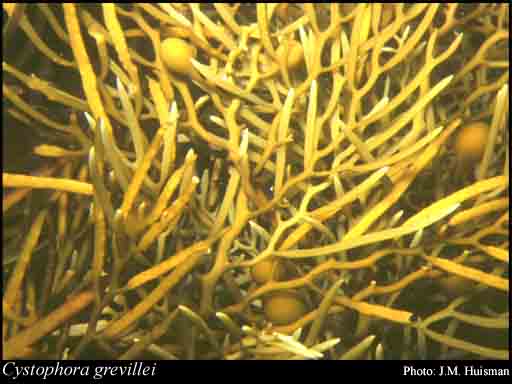
Scientific Description
Habit and structure. Thallus medium to dark brown, moderately robust but loosely branched in the one plane, 0.5–1.5 m long with spreading secondary axes and laterals. Holdfast discoidconical, 0.5–2.5 cm across, with a single primary axis; epilithic. Primary axes more or less terete, 2–5(–7) mm in diameter, alternately distichously branched, usually denuded below with short branch residues; secondary axes normally present and often becoming as long as the primary axis, 0.5–2(–4) cm apart, not or slightly retroflex, of similar thickness to the primary axes; tertiary axes often present. Laterals 4–10 cm long, alternately distichous with 3–8(–12) simple ramuli per lateral, axils rounded, ramuli 2–8(–10) cm long and 1–2 mm in diameter, subterete. Vesicles usually present, replacing the basal 1(–2) ramuli of laterals, stalked, spherical to slightly ovoid, 5–10(–12) mm in diameter, mutic.
Reproduction. Thalli monoecious. Receptacles bisexual, simple, 2–8(–15) cm long, 1–2(–3) mm broad, subterete but drying slightly compressed, linear to slightly torulose, smooth. Conceptacles usually unisexual, more or less adjacent, with ostioles in 2(–3) rows; oogonia sessile, ovoid, 80–105 µm long and 50–65 µm in diameter, with simple paraphyses; antheridia on branched paraphyses, ovoid to elongate-ovoid, 12–20 µm long and 8–12 µm in diameter.
Distribution. From 7 Mile Beach, Dongara, W. Aust., around southern Australia to Wilsons Promontory, Vic., and around Tas.
Habitat. C. grevillei seems to be a deep water species.
[After Womersley, Mar. Benthic Fl. Southern Australia II: 374 (1987)]
Distribution
- IBRA Regions
- Esperance Plains, Geraldton Sandplains, Jarrah Forest, Swan Coastal Plain, Warren.
- IBRA Subregions
- Geraldton Hills, Perth, Recherche, Southern Jarrah Forest, Warren.
- IMCRA Regions
- Central West Coast, Leeuwin-Naturaliste.
- Local Government Areas (LGAs)
- Augusta Margaret River, Bunbury, Busselton, Cockburn, Cottesloe, Esperance, Fremantle, Irwin, Joondalup, Mandurah, Manjimup, Rockingham.