- Reference
- Mar.Benth.Fl.S.Australia 388, figs 143A, 145D (1987)
- Conservation Code
- Not threatened
- Naturalised Status
- Native to Western Australia
- Name Status
- Current
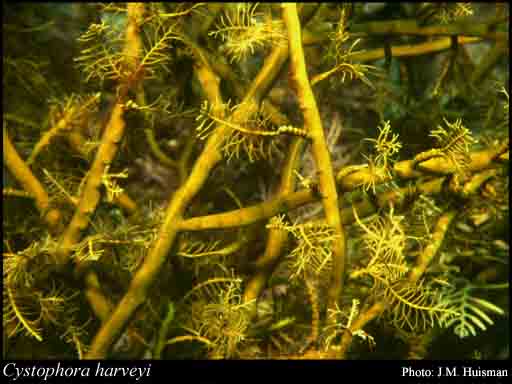
Scientific Description
Habit and structure. Thallus dark brown, usually 30 cm–1 m(–2 m) long, with a robust primary axis bearing relatively robust secondary axes and slender, densely branched, laterals. Holdfast discoid-conical, 5–15 mm across, with a single, subterete stipe; epilithic. Primary axes compressed, 4–6(–8) mm broad below and 2–4 mm thick, lenticular in transverse section with narrower edges, distichously branched at intervals of 2–10 mm with stubby, not retroflex, branch residues; all branches from the face of the axes, attached only to the centre of the face of the parent branch; secondary axes similar to primary axes but 1–3 mm broad. Laterals (1–)2–5 cm long, lax, alternately distichous to 2 orders, slender, with ultimate ramuli terete, 0.5–1.5(–2) cm long and 300–500 µm in diameter, lying largely in one plane but often displaced. Vesicles absent.
Reproduction. Thalli monoecious. Receptacles simple, (2–)3–7(–12) mm long, with a sterile pedicel and short, sterile, apex, terete to usually slightly compressed, slightly verrucose, 600–800 µm broad. Conceptacles with ostioles essentially in two rows, bisexual, with simple paraphyses; oogonia sessile, ovoid, 100–160 µm long and 65–100 µm in diameter, with a single egg; antheridia on branched paraphyses, elongate-ovoid, 16–30 µm long and 7–14 µm in diameter.
Distribution. From South Bunker Bay, Geographe Bay, to William Bay, Walpole, W. Aust.
Habitat. C. harveyi appears to be restricted to the south-west coast of Western Australia, where it can be the dominant species in the uppermost sublittoral (0–5 m deep) on rough-water coasts between Cape Naturaliste and Cape Leeuwin.
[After Womersley, Mar. Benthic Fl. Southern Australia II: 388–390 (1987)]
Distribution
- IBRA Regions
- Jarrah Forest, Warren.
- IBRA Subregions
- Southern Jarrah Forest, Warren.
- IMCRA Regions
- Leeuwin-Naturaliste.
- Local Government Areas (LGAs)
- Augusta Margaret River, Busselton, Manjimup.