- Reference
- Spec.Gen.Ord.Alg. 244 (1848)
- Conservation Code
- Not threatened
- Naturalised Status
- Native to Western Australia
- Name Status
- Current
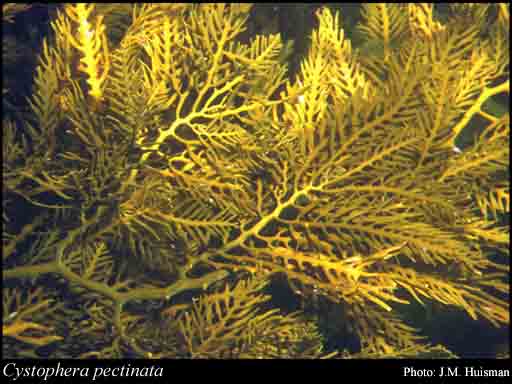
Scientific Description
Habit and structure. Thallus medium to dark brown, 30–80(–100) cm long, with a moderately robust primary axis and complanate branching. Holdfast discoid-conical, 1–2(–3) cm across, with a single primary axis; epilithic. Primary axes terete to slightly compressed, usually ovoid in transverse section, 2–5 mm broad, with alternately distichous laterals and secondary axes from the slightly broader sides of the axes; secondary axes usually 5–20 cm long, not or slightly retroflex, tertiary axes when present usually short (2–4 cm); lower secondary axes often lost, with short, stubby, sometimes scalariform residues 2–8 mm apart. Laterals 1–6(–8) cm long, closely adjacent (1–3 mm apart) and alternately pinnate with simple, compressed ramuli and a narrow midrib with the upper part bearing a marginal wing continuous with the ramuli; ramuli 0.5–1(–2) cm long, 0.5–1.5 mm broad, tapering at base and apex, simple or occasionally with 1–2 branches. Vesicles absent.
Reproduction. Thalli monoecious. Receptacles simple, compressed, apiculate, 0.5–1(–2) cm long and 1–2(–3) mm broad, margins smooth to slightly torulose when fresh, torulose when dried. Conceptacles in two marginal rows with ostioles on the edges, bisexual, with simple paraphyses; oogonia sessile, ovoid, 100–150 µm long and 60–90 µm in diameter; antheridia on branched paraphyses, elongate-ovoid, 20–32 µm long and 10–14 µm in diameter.
Distribution. From Waterman Bay, Perth, W. Aust., to Gulf St Vincent and Kangaroo I., S. Aust., and at Walkerville, Vic.
Habitat. C. pectinata is a deep water species, occasional in the drift from southern coasts of Western Australia to Kangaroo Island, South Australia.
[After Womersley, Mar. Benthic Fl. Southern Australia II: 376 (1987)]
Distribution
- IBRA Regions
- Esperance Plains, Jarrah Forest, Swan Coastal Plain, Warren.
- IBRA Subregions
- Perth, Recherche, Southern Jarrah Forest, Warren.
- IMCRA Regions
- Central West Coast, Leeuwin-Naturaliste, WA South Coast.
- Local Government Areas (LGAs)
- Albany, Augusta Margaret River, Busselton, Cottesloe, Esperance, Mandurah, Manjimup.