- Reference
- Ann.Sci.Nat., Bot. 58 (1905)
- Conservation Code
- Not threatened
- Naturalised Status
- Native to Western Australia
- Name Status
- Current
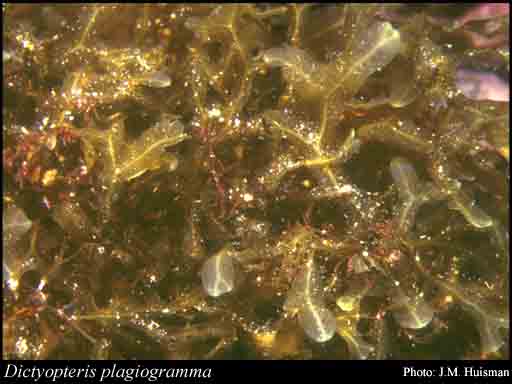
Scientific Description
Habit and structure. Thalli dark olivaceous green to light tan or almost yellowish, occurring as dense often intertwined tufts of multiple axes arising from a common matted holdfast. Fronds 2–8 cm long, 1–8 mm wide, usually crisp in texture and pungently aromatic when fresh. Branching of juvenile thalli basically dichotomous, becoming pseudomonopodial at maturity and then highly irregular as wing tissue wears away to leave midribs as several orders of stalks. Blades from apex to base traversed from midrib to margin by regularly spaced microscopic to faintly visible veins that arise at angles of 10–20° and form broad arches bending away from the apices. Hair tufts forming small spots either parallel to the midrib or irregularly scattered between veins. Adventitious blades occasionally arising in small numbers from the midrib. Cross-sections of blades showing a very narrow monostromatic margin that becomes bilayered toward the interior, reaching 2 or 3 layers just short of the midribs which, in distal blades, are 12–16 cells and 300–400 µm thick, some of the interior cells of the midrib being secondarily thickened.
Reproduction. Sporangia forming linear arrays along, but not traversing, the midrib, to 100–125 µm in diameter, occurring in mixed stages from immature to shed mature contents. Fertile collections very rare (March and May).
Distribution. Widespread in the subtropical to tropical waters of the Caribbean, Atlantic and Indian Oceans, and in the Pacific Ocean, including the southern Great Barrier Reef, Lord Howe I. and Norfolk I.
[After Kraft, Algae of Australia: Marine Benthic Algae of Lord Howe Island and the Southern Great Barrier Reef, 2: Brown Algae:147–148 (2009)]
Distribution
- IBRA Regions
- Swan Coastal Plain.
- IBRA Subregions
- Perth.
- IMCRA Regions
- Abrolhos Islands, Central West Coast, Leeuwin-Naturaliste, Shark Bay, WA South Coast.
- Local Government Areas (LGAs)
- Albany, Cockburn, Dandaragan, Esperance, Greater Geraldton, Irwin, Joondalup, Shark Bay, Wanneroo.