- Reference
- Bull.U.S.Bur.Fish. 36:460 (1920)
- Conservation Code
- Not threatened
- Naturalised Status
- Native to Western Australia
- Name Status
- Current
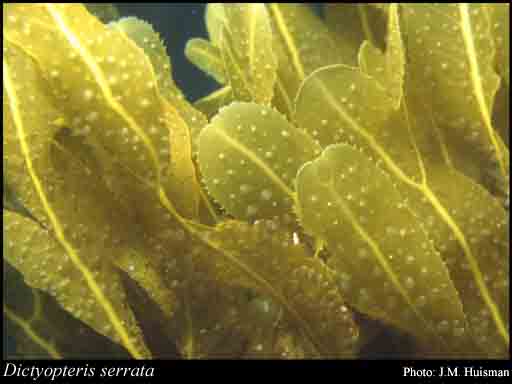
Scientific Description
Habit and structure. Thallus upright, yellow-brown to dark brown, to 45 cm in height, dichotomously branched. Axes flattened, 8–30 mm broad, with a prominent midrib and faint veins running from the midrib in an irregular alternate pattern, extending obliquely towards, but not reaching, the margin. Marginal serrations conspicuous. Lower axes often denuded. Hair tufts scattered across the thallus surface.
Reproduction. Sporangia ovoid or spherical, 120–150 µm in diameter, scattered singly or in small groups of usually two or three. Other reproduction unknown.
Distribution. Known from the North West Cape region to Dongara, W. Aust. South Africa. Mauritius, Mozambique, Réunion.
Habitat. Epilithic in the subtidal.
Distribution
- IBRA Regions
- Geraldton Sandplains, Pilbara.
- IBRA Subregions
- Geraldton Hills, Roebourne.
- IMCRA Regions
- Central West Coast, Ningaloo, Pilbara (nearshore), Pilbara (offshore), WA South Coast.
- Local Government Areas (LGAs)
- Ashburton, Carnarvon, Esperance, Exmouth, Irwin, Karratha.