- Reference
- J.Bot.(Desvaux) 42 (1809)
- Conservation Code
- Not threatened
- Naturalised Status
- Native to Western Australia
- Name Status
- Current
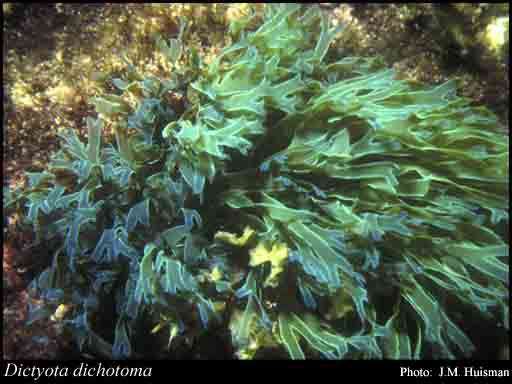
Scientific Description
Habit and structure. Thallus usually medium brown, darker near the base, 2–20 cm long, fairly regularly dichotomously branched at intervals of 0.5–1(–3) cm, branches (2–)3–7(–10) mm broad (down to 1 mm near apices of var. intricata), usually more or less linear and tapering only slightly from lower to upper parts of the thallus, rarely spirally twisted, axils more or less rounded, apices of branches rounded and usually 3–4 mm broad just below the apices (narrower in var. intricata), with occasional specimens tapering in upper 0.5–1 cm to apiculate apices; proliferations usually absent except as a response to damage, occasionally present marginally. Holdfast of rhizoids; mainly epilithic. Cortical cells 14–20 µmacross, L/B1–2(–4). Hair tufts scattered, hairs 10–18 µmin diameter.
Reproduction. Tetrasporangia 70–110 µmin diameter, usually densely scattered (singly or in small groups) over the thallus except close to the margins. Oogonia in scattered, irregularly ovate sori 150–400 µmlong and 120–250 µmacross; oogonia 60–90 µmlong and 30–50 µmin diameter. Antheridia in scattered, ovate to irregularly elongate sori (150–)250–600 µmlong and 150–250 µmacross; antheridia 60–80 µmlong and 20–30 µm in diameter.
Distribution. From Whitford Beach, W. Aust., around southern Australia and Tas., to southern Qld.; probably further north on both eastern and western coasts.
Habitat. In sheltered areas such as American R. inlet on Kangaroo I., Venus Bay and Port Clinton, plants are narrower than normal, with long interbranch segments, and are placed in var. intricata (C.Agardh) Grev.; to what extent this variation is ecological is not established.
[After Womersley, Mar. Benthic Fl. Southern Australia II:194–196 (1987)]
Distribution
- IBRA Regions
- Esperance Plains, Geraldton Sandplains, Swan Coastal Plain, Warren, Yalgoo.
- IBRA Subregions
- Edel, Geraldton Hills, Perth, Recherche, Warren.
- IMCRA Regions
- Abrolhos Islands, Canning, Leeuwin-Naturaliste, Pilbara (nearshore), Shark Bay, WA South Coast.
- Local Government Areas (LGAs)
- Busselton, Cockburn, East Fremantle, Esperance, Greater Geraldton, Karratha, Manjimup, Rockingham, Shark Bay, South Perth.