- Reference
- Spec.Gen.Ord.Alg. 146 (1848)
- Conservation Code
- Not threatened
- Naturalised Status
- Native to Western Australia
- Name Status
- Current
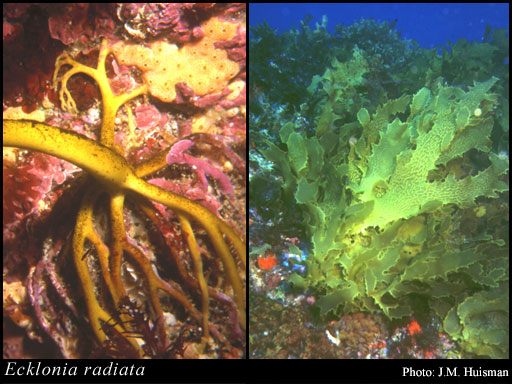
Brown marine subtidal alga, epilithic, upright, to 2 m tall; holdfast hapteroid; stipe single, terete; blade complanate, irregularly distichously branched, leathery, with smooth, corrugate, or spinous surface.
Scientific Description
Habit and structure. Thallus dark brown, 0.3–2 m high, with a single stipe bearing a complanate blade with distinct laterals. Holdfast more or less conical, usually 5–10 cm across and high, with subdichotomous haptera 2–4 mm in diameter; epilithic. Stipe simple, terete, solid, 2–20(–100) cm long, and 2–12 mm in diameter. Blade differentiating at its base, with laterals usually developing rapidly from meristems at their bases, more or less alternately distichous; central blade usually smooth, occasionally with surface spines, 1.5–8(–10) cm broad. Laterals 5–20(–40) cm long, 1–10 cm broad, basally narrowed, simple to lobed, smooth to corrugate and often spiny (especially in rough-water forms), margin usually spiny; spines broad-based, mostly 2–4(–10) mm long. Structure of a central filamentous medulla and outer cellular cortex with a surface meristoderm; outer cells with numerous discoid phaeoplasts.
Reproduction.By extensive, usually inconspicuous, sori mostly on the central blade but often also on the laterals, ovate to irregular in shape; unilocular sporangia clavate, 30–55 µmlong and 8–12 µm in diameter, accompanied by clavate paraphyses 50–70 µmlong and 4–7 µmin diameter.Gametophytes 100–400 µmacross, from few to many celled, the female with few branches, cells irregularly swollen, 12–30 µmin diameter, forming eggs in terminal cells, the male much-branched, cells 4–8(–10) µmin diameter, with small, lateral antheridia.
Distribution.From Kalbarri and the Houtman Abrolhos Is, W. Aust., around southern Australia and Tas., to Caloundra, Qld.
Habitat. Common and often dominant in the upper sublittoral under moderate wave action, and deeper (to 44 m) on rough-water coasts.
[After Womersley, Mar. Benthic Fl. Southern Australia II: 332–334 (1987)]
Distribution
- IBRA Regions
- Esperance Plains, Geraldton Sandplains, Jarrah Forest, Swan Coastal Plain, Warren.
- IBRA Subregions
- Geraldton Hills, Perth, Recherche, Southern Jarrah Forest, Warren.
- IMCRA Regions
- Abrolhos Islands, Central West Coast, Leeuwin-Naturaliste, WA South Coast.
- Local Government Areas (LGAs)
- Albany, Busselton, Cambridge, Cockburn, Dandaragan, Esperance, Greater Geraldton, Irwin, Joondalup, Manjimup, Northampton, Rockingham.