- Reference
- Phycol.Austral. pl. 62 (1859)
- Conservation Code
- Not threatened
- Naturalised Status
- Native to Western Australia
- Name Status
- Current
Scientific Description
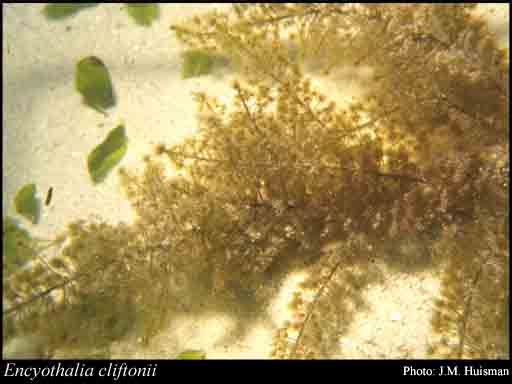
Habit and structure. Thallus medium to dark brown, (10–)20–100 cm long, with a single percurrent axis developing radially long lateral branches fringed with numerous, short, slender branchlets 5–15 mm long, 1–3 mm apart, borne at right angles, each with a prominent apical tuft of assimilatory filaments; attachment by a rhizoidal holdfast 2–12 mm across and 2–7 mm long; epilithic. Growth apical, with a convex branch meristem (usually with slight shoulders) surmounted by a dense tuft of trichothallic filaments 2–7 mm long, with similar tufts at the apex of each branchlet, each filament with a meristem 5–8 cells above the base, 30–40 µm in diameter above with cells L/B 2–3. Fronds terete, with a robust axis 1.5–2(–3) mm in diameter below and usually becoming stupose or felt-like with rhizoids, decreasing to 0.5–1 mm in diameter above and in the 10–20 cm long laterals, apices often becoming frayed, with the slender branchlets 150–200 µm in diameter. Structure haplostichous and pseudoparenchymatous, with a medulla of elongate cells and the single-layered cortex becoming multi-layered in the axis and laterals by periclinal divisions, with the surface cells (5–)7–9 µm across and L/B (1.2– )1.5– 2(–2.5).
Reproduction. Sporangial sori surrounding the lateral branches or the upper axis for lengths of 4–10 cm, including the base of the slender, sterile, branchlets, 1–1.5(–2) mm in diameter. Paraphyses compact, simple, 200–240 µm and 10–15 cells long, clavate with the upper 2–3 cells larger, 12–14 µm in diameter, with the apical cell ovoid to slightly conical, L/B 1.2–1.5. Unilocular sporangia borne laterally on the central cells of the paraphyses, 25–30(–40) µm long and 7–9 µm in diameter.Gametophyte unknown.
Distribution. From Kalbarri and the Houtman Abrolhos, W. Aust., to Guichen Bay, S. Aust. and Walkerville, Vic.
Habitat. E. cliftonii is an elegant, deep water, species (5–17 m deep), often common from W. Aust. to Victor Harbor, S. Aust.
[After Womersley, Mar. Benthic Fl. Southern Australia II: 289–290 (1987)]
Distribution
- IBRA Regions
- Esperance Plains, Geraldton Sandplains, Swan Coastal Plain.
- IBRA Subregions
- Geraldton Hills, Perth, Recherche.
- IMCRA Regions
- Abrolhos Islands, Central West Coast, Leeuwin-Naturaliste, WA South Coast.
- Local Government Areas (LGAs)
- Dandaragan, Esperance, Fremantle, Greater Geraldton, Irwin, Joondalup, Mandurah, Northampton, Rockingham.