- Reference
- Phycol.Austral. pl LXXXVI (1859)
- Conservation Code
- Not threatened
- Naturalised Status
- Native to Western Australia
- Name Status
- Current
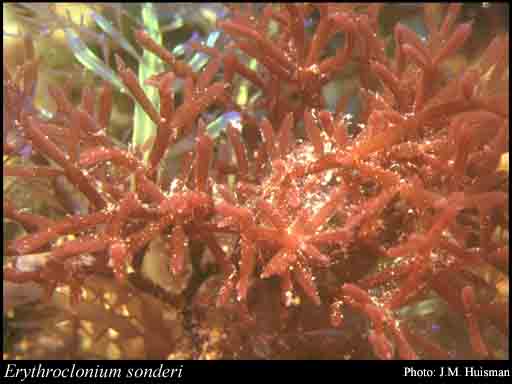
Scientific Description
Habit and structure. Thallus medium to dark red, (5–)10–15 cm high, much branched with clavate to elongate-ovoid segments (4–)6–10(–20) mm long and (1.5–)2–3(–4) mm in diameter, markedly constricted, with 2–4(–7) branches from segment apices; lower branches becoming thickened (1–2 mm) and terete, though original segments usually still indicated. Holdfast discoid, 2–7 mm across, with 1–4 axes; epilithic. Structure uniaxial, with each axial cell producing two periaxial filaments at about 90°, alternating on successive cells, with rhizoids surrounding the conspicuous axial filament; medulla lax in upper segments, becoming filled with rhizoids in thickened branches. Cortex pseudoparenchymatous, 2–3(–4) cells thick, inner cells ovoid and 20– 30 µm in diameter, outer cells 6–14 µm in diameter, L/D 1–1.5, in thickened parts forming files 6–12 cells long. Rhodoplasts discoid to ribbon shaped, several per cell.
Reproduction. Carpogonial branches 3-celled, borne on inner cortical cells, directed inwards with reflexed trichogynes. Connecting filaments and auxiliary cells not observed. Carposporophytes with a central fusion cell and radiating gonimoblasts with terminal chains of ovoid carposporangia 20–25 µm in diameter. Cystocarps lying within the medulla, with filamentous enveloping tissue, slightly swelling the segment, ostiolate. Spermatangia unknown. Tetrasporangia scattered in the cortex, developed from inner cortical cells and pit-connected laterally, protruding markedly into the medulla, ovoid, 150–175 µm long and 65–90 µm in diameter, zonately divided.
Distribution. Dongara, W. Aust., to Robe, S. Aust., and the N coast of Tas.
[After Womersley, Mar. Benthic Fl. Southern Australia IIIA: 355–356 (1994)]
Distribution
- IBRA Regions
- Geraldton Sandplains, Swan Coastal Plain, Warren.
- IBRA Subregions
- Geraldton Hills, Perth, Warren.
- IMCRA Regions
- Abrolhos Islands, Central West Coast, Leeuwin-Naturaliste, Pilbara (nearshore), Pilbara (offshore), WA South Coast.
- Local Government Areas (LGAs)
- Ashburton, Augusta Margaret River, Busselton, Cockburn, Cottesloe, Esperance, Greater Geraldton, Irwin, Joondalup, Karratha, Mandurah, Rockingham.