- Reference
- Austral.J.Bot. 269-275, figs 13 B-J 14 A-H, pl 4 (1968)
- Conservation Code
- Not threatened
- Naturalised Status
- Native to Western Australia
- Name Status
- Current
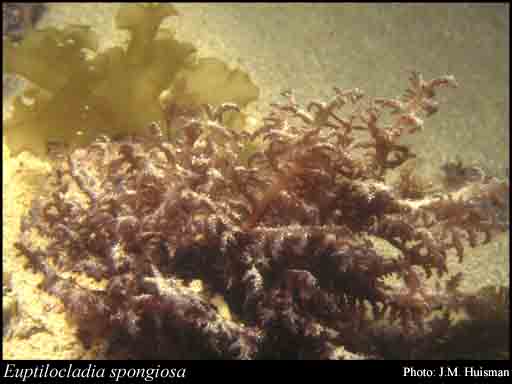
Scientific Description
Habit and structure. Thallus medium to dark red-brown, 5–18 cm high, spongiose, more or less alternately distichously branched throughout, usually with a single main axis, much branched above for 4 or 5 orders, axes compressed, 1–4 mm broad, decreasing gradually to lesser branches 0.5–1 mm broad; main branches usually with numerous short, distichous, terete laterals 1–5 mm long; branches completely covered by whorl-branchlets. Holdfast conical, rhizoidal, 1–3 mm across; epilithic or occasionally epiphytic. Structure. Axes with small apical cells enlarging to 90–150 µm in diameter and L/D 1–1.5, each cell with 4 whorl-branchlets initiated very close to apices of axes, with 2 opposite longer branchlets 400–650 µm and 10–14 cells long, branched 6–8 times with terminal rows of 3–8 cells, and 2 opposite shorter branchlets 180–300 µm and 8–10 cells long; lower cells of whorl-branchlets thick walled, 50–90 µm in diameter and L/D 1–1.6, tapering to rows of small cells 8–10 µm in diameter and L/D 1–1.5. Lateral branches arise from the basal cells of whorl-branchlets and the axial cells become heavily corticated by rhizoids from the basal and inner cells of whorl-branchlets. Cells uninucleate; rhodoplasts discoid.
Reproduction. Gametophytes probably dioecious. Procarps borne in place of a whorl-branchlet several cells below apices, with a supporting cell bearing a 4-celled carpogonial branch; post-fertilization the auxiliary cell forms a lower foot cell and a laterally elongate cell which cuts off 2 gonimolobes and later further ones, 90–120 µm across with somewhat angular carposporangia 20–30 µm across. Mature carposporophytes are surrounded by whorl-branchlets in short determinate branches. Spermatangia unknown. Tetrasporangia are borne on central cells of the whorl-branchlets, sessile, subspherical, 35–55 µm in diameter, tetrahedrally divided.
Distribution. Houtman Abrolhos, W. Aust., to Waratah Bay, Vic.
[After Womersley, Mar. Benthic Fl. Southern Australia IIIC: 53–55 (1998)]
Distribution
- IBRA Regions
- Swan Coastal Plain.
- IBRA Subregions
- Perth.
- IMCRA Regions
- Central West Coast, Leeuwin-Naturaliste.
- Local Government Areas (LGAs)
- Cambridge, Cockburn, Cottesloe, Dandaragan, Mandurah, Rockingham, Wanneroo.