- Reference
- Phycologia 441,443-445, figs 59-69 (1986)
- Conservation Code
- Not threatened
- Naturalised Status
- Native to Western Australia
- Name Status
- Current
Scientific Description
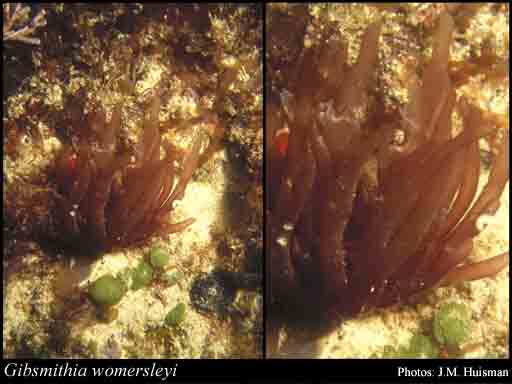
Habit and structure. Thallus red-brown, fading to grey-brown, erect, 3–48 cm high, with a short, cartilaginous stalk 4–11 mm broad bearing terete to compressed, linear to irregularly branched mucilaginous branches 2–30 mm in diameter, branched at intervals of 2–20 cm, ends rounded. Holdfast crustose to conical, cartilaginous, 4–11 mm across; epilithic or on jetty piles. Structure multiaxial, with a filamentous medulla of long cells 7–10 µm in diameter, producing numerous rhizoids 4–5 µm in diameter; the latter may fuse laterally with other filaments, or medullary filaments may fuse directly; cortical filaments pseudodichotomous, 9–15 cells long, cells 4–6 µm in diameter and L/D 4–7 below, apical cells 3–4 µm in diameter and L/D 3–6, with occasional hairs; rhodoplasts parietal, becoming dissected in inner cells.
Reproduction. Sexual thalli dioecious. Carpogonial branches 6–8(–11) cells long, with the mid and upper cells enlarged, the hypogynous cell largest and excentric; short, sterile, lateral filaments occasionally present. Auxiliary cell branches 9–19 cells long, terminating as vegetative cells, and the basal 3–4 cells bearing 1–5 usually unbranched laterals; auxiliary cell smaller than adjacent cells, trapezoidal in shape. Carposporophytes at first with discrete gonimolobes, when mature 120–250 µm in diameter, with ovoid to angular carposporangia 8–15 µmin diameter and 10–35 µm long. Spermatangia clustered, cut off from initials at ends of cortical filaments. Tetrasporophytes with clustered tetrasporangia on ends of cortical filaments, cruciately (usually decussately) divided, ovoid, 15–25 µm in diameter.
Distribution.Only known from the type collection, Hopetoun, W. Aust., and Waterloo Bay (Elliston), S. Aust.
[After Womersley, Mar. Benthic Fl. Southern Australia IIIA: 228–229 (1994)]
Distribution
- IBRA Regions
- Warren.
- IBRA Subregions
- Warren.
- IMCRA Regions
- Leeuwin-Naturaliste, WA South Coast.
- Local Government Areas (LGAs)
- Augusta Margaret River, Esperance.