- Reference
- Mém.Soc.Sci.Nat.Cherbourg 27:223 (1891)
- Conservation Code
- Not threatened
- Naturalised Status
- Native to Western Australia
- Name Status
- Current
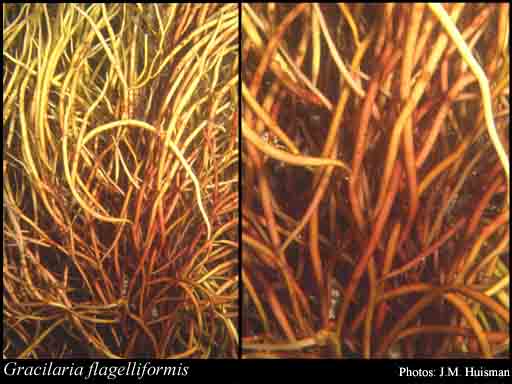
Scientific Description
Habit and structure. Thallus to 8 cm tall, deep red to brownish red, arising from a discoid holdfast, distinctly flattened; branches 4–8 mm broad, with lateral branches arising from the blade margins, slightly thinner at insertion and curving toward the apex. Structure pseudoparenchymatous, with medulla of large hyaline cells 100–200 µm in diameter, grading outwardly to a cortex of 2–3 layers of smaller pigmented cells. Epidermal cells 7–10 µm in diameter in surface view.
Reproduction. Reproductive structures not observed.
Distribution. Warmer seas of the Indo-Pacific; in W. Aust., known from the Houtman Abrolhos (Huisman) and Broome.
Distribution
- IBRA Regions
- Dampierland, Geraldton Sandplains.
- IBRA Subregions
- Geraldton Hills, Pindanland.
- IMCRA Regions
- Abrolhos Islands, Kimberley, Pilbara (offshore).
- Local Government Areas (LGAs)
- Ashburton, Broome, Greater Geraldton.