- Reference
- Voy.Pôle Sud 1:149, footnote (1845)
- Conservation Code
- Not threatened
- Naturalised Status
- Native to Western Australia
- Name Status
- Current
Scientific Description
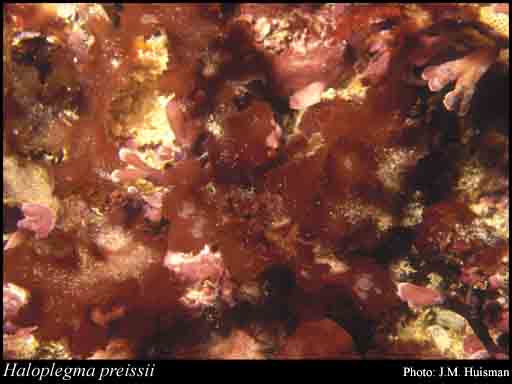
Habit and structure. Thallus red-brown, flat and complanately branched, (5–)10–20 cm high, much branched with main branches 5–10 mm broad bearing laterals marginally of various sizes for 3 or 4 orders, mostly 1–2 mm thick, ultimate branches lobed to pointed, margins smooth, surface felt like. Stipe 2–20 mm long, 1–3 mm broad, holdfast rhizoidal, 2–10 mm across; epilithic or epiphytic on Amphibolis. Structure. Marginal apices regularly fringing the blades but not conspicuous due to overtopping by long, curved filaments of the surface clusters; rectangular network filaments present but not conspicuous, cells 35–55 µm in diameter and L/D 3–8(–20). Surface clusters 400–700 µm long, basally branched but with long, unbranched, curved, gently tapering ends 250–500 µm and 15–32 cells long, cells 18–30 µm in diameter and L/D 1–1.5. Cells multinucleate; rhodoplasts discoid to elongate.
Reproduction. Gametophytes dioecious. Carpogonial branches borne on short branches on lower cells of surface clusters, details uncertain. Carposporophytes lying within and loosely surrounded by filaments of the surface clusters, with 3–5 rounded gonimolobes 400–700 µm across, all cells forming ovoid carposporangia 10–20 µm in diameter. Spermatangial heads terminal on the unbranched filaments of the surface clusters, ovoid, 25–35 µm in diameter, with 5–8 axial cells bearing whorls of cells producing spermatangia. Tetrasporangia terminal on short branches from the lower to mid cells of the (otherwise) unbranched surface filaments, slightly ovoid, 20–45 µm in diameter, tetrahedrally divided.
Distribution. Widespread in tropical waters, especially the Indian Ocean. In southern Australia, from Shark Bay, W. Aust., to Walkerville, Vic., and around Tas.
Habitat. H. preissii is a common alga on rough-water coasts of southern and south-western Australia, ranging from shaded pool situations to deep water.
[After Womersley, Mar. Benthic Fl. Southern Australia IIIC: 284–286 (1998)]
Distribution
- IBRA Regions
- Carnarvon, Dampierland, Esperance Plains, Geraldton Sandplains, Jarrah Forest, Swan Coastal Plain, Warren, Yalgoo.
- IBRA Subregions
- Edel, Geraldton Hills, Perth, Pindanland, Recherche, Southern Jarrah Forest, Warren, Wooramel.
- IMCRA Regions
- Abrolhos Islands, Central West Coast, Leeuwin-Naturaliste, Pilbara (offshore), WA South Coast.
- Local Government Areas (LGAs)
- Ashburton, Augusta Margaret River, Broome, Busselton, Cambridge, Cockburn, Coorow, Cottesloe, Dandaragan, Esperance, Fremantle, Greater Geraldton, Irwin, Mandurah, Perth, Rockingham, Shark Bay, Wanneroo.