- Reference
- Bahama Fl. 590 (1920)
- Conservation Code
- Not threatened
- Naturalised Status
- Native to Western Australia
- Name Status
- Current
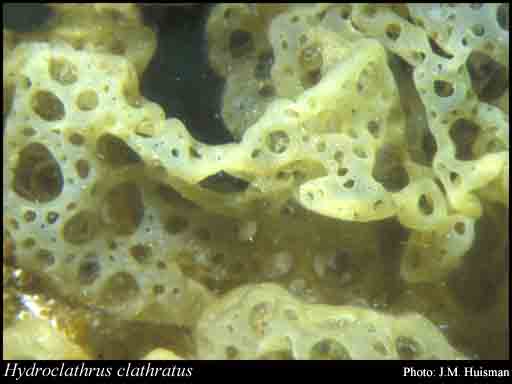
Scientific Description
Habit and structure. Thallus medium to dark brown, (5–)10–25(–35) cm across and 3–15 cm high, at first globular to pulvinate, hollow, and soon becoming clathrate, when larger becoming irregularly lobed and often torn with an expanded, clathrate, membrane; holes variable in size and arrangement, round to ovoid, 2 mm–2(–4) cm across, with the membrane 1–4 mm broad, with a broad, diffuse, rhizoidal attachment, epilithic or epiphytic. Structure of membrane with an inner, large-celled medulla 3–5(–6) cells thick, and a small-celled cortex 1(–2) cells thick, often with the margins inrolled and becoming attached by short rhizoidal extensions from the cortical cells, thus forming elongate vesicles with the medulla and cortex all around; surface cortical cells isodiametric, 6–10 µm across, each with a single phaeoplast and pyrenoid; phaeophycean hairs in groups, scattered, 12–15 µm in diameter.
Reproduction. Sori of plurilocular reproductive organs usually present on young thalli, extending over the outer surface of the net with remnants present on older thalli, surrounding or accompanied by hair groups; plurilocular organs uniseriate or biseriate, 15–20 µm and 3–5 locules long, 4–5 µm in diameter, with 2–4 rows corresponding to each cortical cell; paraphyses absent.
Distribution.In Australia, all around the mainland coast but not in Tas.
Habitat. From just above low tide level to 25 m deep.
[After Womersley, Mar. Benthic Fl. Southern Australia II: 300–302 (1987)]
Distribution
- IBRA Regions
- Carnarvon, Esperance Plains, Geraldton Sandplains, Indian Tropical Islands, Northern Kimberley, Pilbara, Swan Coastal Plain, Yalgoo.
- IBRA Subregions
- Cape Range, Edel, Geraldton Hills, Mitchell, Perth, Recherche, Roebourne.
- IMCRA Regions
- Abrolhos Islands, Anson Beagle, Canning, Central West Coast, Kimberley, Leeuwin-Naturaliste, Ningaloo, North West Shelf, Oceanic Shoals, Pilbara (nearshore), Pilbara (offshore), Shark Bay, WA South Coast.
- Local Government Areas (LGAs)
- Ashburton, Augusta Margaret River, Broome, Carnarvon, Cockburn, Cocos Islands, Dandaragan, Derby-West Kimberley, Esperance, Exmouth, Greater Geraldton, Irwin, Jerramungup, Karratha, Northampton, Port Hedland, Rockingham, Shark Bay, Wyndham-East Kimberley.