- Reference
- Spec.Gen.Ord.Alg. 772 (1852)
- Conservation Code
- Not threatened
- Naturalised Status
- Native to Western Australia
- Name Status
- Current
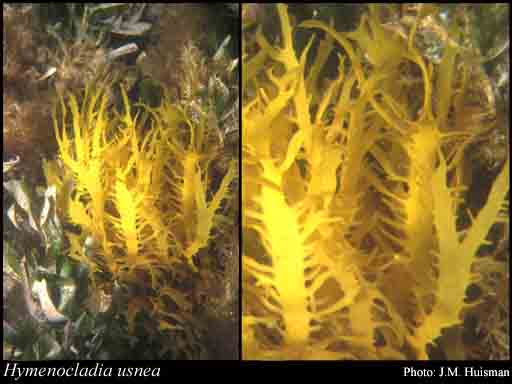
Scientific Description
Habit and structure. Thallus erect, medium red to dark red-brown, 10–30 cm high, complanately and pinnately to tri-pinnately branched, branch axes 2–8 mm broad and usually broadest centrally, bearing closely set, compressed, marginal laterals 1–3 mm broad, the ultimate ramuli compressed, 2–10(–20) mm long and 1–2 mm broad, simple or furcate. Holdfast discoid, around the host stems and 1–3 mm across, bearing one to several fronds; epiphytic on Amphibolis and possibly epilithic. Structure multiaxial, developing a cortex 2–3(–4) cells thick, outer cells ovoid to elongate and 2–3 µm in diameter, grading over 1–2 cells to the medulla 2–4 cells across, larger inner cells ovoid (in branch transverse section) and 100–150 µm in diameter with walls 4–10 µm thick, with interspersed smaller ovoid cells 20–40 µm in diameter; secondary pit-connections frequent. Rhodoplasts ovoid to elongate, in chains in inner cells.
Reproduction. Gametangial thalli dioecious (or monoecious?). Carpogonial branches 4-celled, borne with a 2-celled auxiliary cell branch on inner cortical cells. Carposporophytes with a basal, branched, fusion cell complex with the upper cells all forming carposporangia, with secondary lobes developed later; carposporangia ovoid to angular, 40–90 µm across. Basal nutritive tissue well developed with vertical chains of cells, erect filaments disintegrating early. Cystocarps scattered, hemispherical to conical, 1–1.5 mm in diameter; pericarp 160–200 µm and 8–16 cells thick, cells ovoid (innermost cells slightly stellate), with a prominent ostiole. Spermatangia in discrete surface sori 200–800 µm across, with ovoid spermatangia 2–3 µm in diameter cut off from elongate initials on outer cortical cells. Tetrasporangia scattered, transformed from intercalary inner cortical or outer medullary cells, subspherical to ovoid, 70–140 µm in diameter, tetrahedrally divided.
Distribution.Port Denison, W. Aust., to Walkerville, Vic., and Kent I, Bass Strait.
[After Womersley, Mar. Benthic Fl. Southern Australia IIIB: 107–109 (1996)]
Distribution
- IBRA Regions
- Esperance Plains, Swan Coastal Plain, Warren.
- IBRA Subregions
- Perth, Recherche, Warren.
- IMCRA Regions
- Abrolhos Islands, Central West Coast, Leeuwin-Naturaliste, WA South Coast.
- Local Government Areas (LGAs)
- Augusta Margaret River, Busselton, Dandaragan, Esperance, Greater Geraldton, Irwin, Mandurah.