- Reference
- Spec.Gen.Ord.Alg. 561 (1876)
- Conservation Code
- Not threatened
- Naturalised Status
- Native to Western Australia
- Name Status
- Current
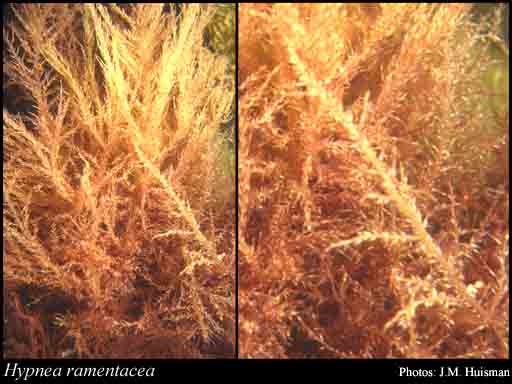
Scientific Description
Habit and structure. Thallus dark red, (6–)10–25 cm high, often with an entangled base and erect percurrent axes bearing dense, radial, laterals of varying lengths, lower thallus branches often relatively bare, elsewhere with numerous short spinous branchlets especially on central parts of axes and branches, and with many axes, longer branches and lower laterals terminating in thickened hamate ends; all branches terete or subterete, axes 0.5–1(–1.2) mm in diameter below, lesser branches 200–400 µm in diameter, basally not or slightly constricted. Attachment mainly by lower hamate branches, probably with a discoid holdfast when young; usually epiphytic. Structure uniaxial with a protruding apical cell, axial filament recognisable throughout, becoming 25–80(–100) µm in diameter with cells L/D 4–6, surrounded by a medulla 2–3 cells broad, cells ovoid and 40–100(–200) µm in diameter with numerous secondary pit-connections, and a small-celled cortex 1–2 cells broad, outer cells 4–9 µm in diameter and L/D 1–2. Rhodoplasts discoid, several to numerous per cell.
Reproduction. Sexual thalli dioecious. Carpogonial branches and early post-fertilization stages not observed. Carposporophyte with a lax reticulum of elongate cells arising basally and pit-connected to inner pericarp cells, with shorter cells producing clusters of small cells which cut off single, subspherical to ovoid, carposporangia 20–35 µm in diameter. Cystocarps sessile, broad based, conical to globular, (600–)750–1000 µm in basal diameter, with a pericarp 4–8 cells thick, slightly beaked, ostiolate. Spermatangia borne in sori surrounding lower to mid parts of lateral branchlets or lesser branches, with initials from outer cortical cells producing chains of 3–5 ovoid spermatangia 2–3 µm in diameter. Tetrasporangia in swollen nemathecia partly or wholly around the lateral branchlets or lesser branches just above their bases, laterally to basally pit-connected to inner cortical cells, ovoid, 40–65 µm long and 20–38 µm in diameter, zonately divided successively but rapidly.
Distribution.Port Denison, W. Aust., to Walkerville, Vic., and the N coast of Tas.
Habitat. H. ramentacea is a common species on rough-water coasts, epiphytic on a variety of other algae.
[After Womersley, Mar. Benthic Fl. Southern Australia IIIA: 440–441 (1994)]
Distribution
- IBRA Regions
- Esperance Plains, Geraldton Sandplains, Jarrah Forest, Swan Coastal Plain, Warren.
- IBRA Subregions
- Geraldton Hills, Perth, Recherche, Southern Jarrah Forest, Warren.
- IMCRA Regions
- Abrolhos Islands, Central West Coast, Leeuwin-Naturaliste, WA South Coast.
- Local Government Areas (LGAs)
- Albany, Augusta Margaret River, Busselton, Cockburn, Cottesloe, Esperance, Fremantle, Greater Geraldton, Mandurah, Manjimup, Northampton, Rockingham, Wanneroo.