- Reference
- Bot.Zeit. 54 (1845)
- Conservation Code
- Not threatened
- Naturalised Status
- Native to Western Australia
- Name Status
- Current
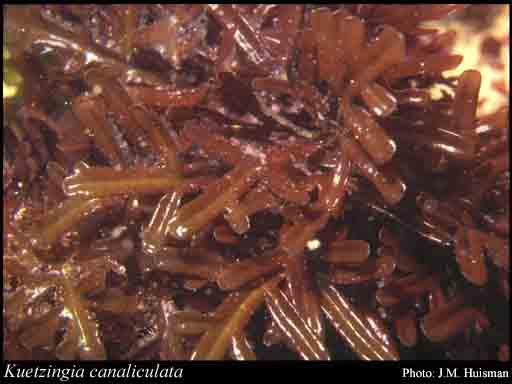
Scientific Description
Habit and structure. Thallus dark red-brown, 10–50 cm high, complanately branched with fairly regular (unless broken) opposite branches for 2–3 orders, branches 2–15 mm apart, axils broad, ultimate branches (1–)2–6 cm long, branches flat, linear, (2–)3–5(–6) mm broad, corticated, midrib present, apices rounded with a slight notch, apex and often margins inrolled. Axes thickened and denuded below, 2–4 mm broad. Holdfast discoid-conical, 4–10 mm across; epilithic. Structure. Apex inrolled, with a dome-shaped apical cell. Pericentral cells 6, 2 large lateral cells, 2 smaller dorsal and 2 (smallest) ventral cells, often with 1–4 interposed pseudopericentral cells. Wings with a single central layer of large cells and a small-celled cortex 2–3 cells broad, with a secondary cortex over the midrib. Opposite, endogenous, lateral filaments arise every (2–)4–10 axial cells. Trichoblasts occur at the ends of the endogenous lateral filaments. Cells uni- or multinucleate; rhodoplasts discoid, chained in larger cells.
Reproduction. Gametophytes dioecious. Procarps occur on terete marginal and surface laterals. Carposporophytes and cystocarps little known. Spermatangial heads subspherical, 100–150 µm in diameter, borne on large basal cells of unbranched trichoblasts in dorsal series on laterals. Tetrasporangial stichidia occur in clusters at the ends of the endogenous filaments, submarginally or from the surface on both surfaces, linear, compressed, 0.5–2 mm long and 200–400 µm broad, with 2 rows of paired tetrasporangia 150–200 µm in diameter.
Distribution.Dongara to Point D' Entrecasteaux, W. Aust., and Wanna, S. Aust.
[After Womersley, Mar. Benthic Fl. Southern Australia IIID: 378 (2003)]
Distribution
- IBRA Regions
- Geraldton Sandplains, Swan Coastal Plain, Warren.
- IBRA Subregions
- Geraldton Hills, Perth, Warren.
- IMCRA Regions
- Central West Coast, Leeuwin-Naturaliste, WA South Coast.
- Local Government Areas (LGAs)
- Augusta Margaret River, Cockburn, Coorow, Cottesloe, Dandaragan, Esperance, Greater Geraldton, Irwin, Joondalup, Mandurah, Manjimup, Rockingham, Wanneroo.