- Reference
- Linnaea 15:20-21 (1841)
- Conservation Code
- Not threatened
- Naturalised Status
- Native to Western Australia
- Name Status
- Current
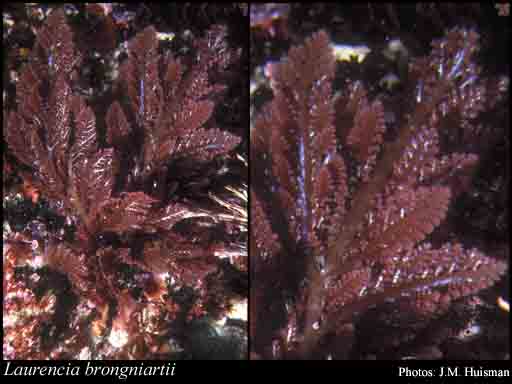
Scientific Description
Habit and structure. Thallus medium red to red-brown, firm, drying cartilaginous, 5–18 cm high, with one to several axes, complanately and regularly pinnately branched; axes strongly compressed, 1.5–4 mm broad and 0.5–1 mm thick, decreasing to ultimate branchlets 0.5–1(–1.5) mm broad, with truncated apices. Holdfast discoid, becoming branched and 2–12 mm across, sometimes stoloniferous; epilithic. Structure. Epidermal cells 25–40 µm broad and slightly elongate near apices, increasing to 60–80 µm broad and L/D 2–2.5 below, with secondary pit-connections and corps en cerise, in section quadrate to L/D 3, occasionally palisade-like; cortical cells compact, often with prominent lenticular thickenings. Cells (epidermal) binucleate; rhodoplasts discoid to elongate, chained in larger cells.
Reproduction. Gametophytes dioecious. Procarps not observed. Carposporophytes with a small basal fusion cell and branched gonimoblast bearing clavate terminal carposporangia 30–70 µm in diameter. Cystocarps lateral and usually single, broad based, globular to slightly ovoid, 600–1300 µm in diameter; pericarp ostiolate, without or with a slight neck, 4–5 cells thick. Spermatangial ramuli single or grouped, receptacles 600–800 µm broad. Tetrasporangia in simple or clustered terete ramuli, 300–600(–800) µm in diameter and (0.5–)1–2 mm long, cut off abaxially in parallel arrangement, 70–120(–135) µm in diameter, tetrahedrally or decussately divided.
Distribution. Widespread in tropical and subtropical waters, including the entire coasts of N.S.W. and Western Australia. In southern Australia, isolated records from several localities.
[After Womersley, Mar. Benthic Fl. Southern Australia IIID: 477–480 (2003)]
Distribution
- IBRA Regions
- Dampierland, Esperance Plains, Geraldton Sandplains, Swan Coastal Plain, Yalgoo.
- IBRA Subregions
- Edel, Geraldton Hills, Perth, Pindanland, Recherche.
- IMCRA Regions
- Abrolhos Islands, Central West Coast, Kimberley, Leeuwin-Naturaliste, Pilbara (nearshore), Pilbara (offshore), WA South Coast, Zuytdorp.
- Local Government Areas (LGAs)
- Ashburton, Augusta Margaret River, Broome, Busselton, Carnarvon, Cockburn, Coorow, Dandaragan, Derby-West Kimberley, Esperance, Greater Geraldton, Karratha, Rockingham, Shark Bay, Wanneroo.