- Reference
- Algas Marin.Bentôn.Brasil 217 (1977)
- Conservation Code
- Not threatened
- Naturalised Status
- Native to Western Australia
- Name Status
- Current
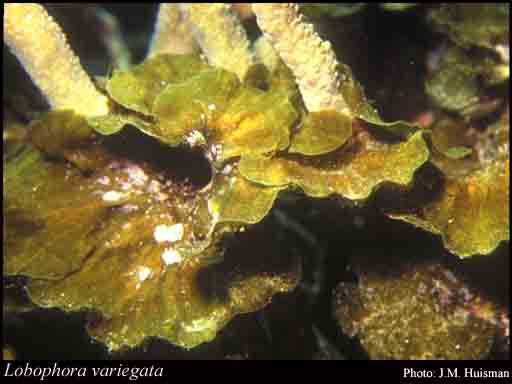
Scientific Description
Habit and structure. Thallus medium to dark brown, drying dark brown to black, 4–10(–14) cm long and as much across, decumbent (almost prostrate) to more or less erect, broadly flabellate, simple to irregularly lacerate or branched with clustered fronds, narrow and stupose below, attached by a matted, rhizoidal holdfast 0.2–1 cm across and 0.5–1.5 cm long; epilithic. Fronds complanate, flabellate, 1–4 cm across apically, 2–10 mm across below, faintly concentrically zoned with growth and hair lines. Growth from an extensive marginal row of apical cells. Structure (5–)7–9(–11) cells and (120–)150–200 µm thick, cells in regular rows in transverse section but with the central layer of cells distinctly larger and the cortical cells nearly all paired; with (3–)4(–6) cortical cells corresponding to each elongate medullary cell lengthwise (the outer medullary cells often subdivided once lengthwise), (8–)10–12(14) µm across in surface view and L/B1–2(–4); rhizoids moniliform with ovoid cells. Hair tufts phaeophycean, on both sides of the thallus, scattered or more or less in concentric lines, hairs 15–25 µmin diameter.
Reproduction. Sori of sporangia scattered on both surfaces, irregularly ovate, (0.5–)1–3 µm long and across, indusiate and without cellular paraphyses; sporangia clavate to pyriform, 100–150(–180) µmlong and 60–95 µmin diameter, without a stalk cell, forming eight (or occasionally four) spores. Oogonia in scattered sori, ovoid, without a stalk cell. Antheridia unknown.
Distribution.Throughout Western Australia to southern Australia to Aldinga, S. Aust., with one record from Port Phillip Heads, and from Port Kembla, N.S.W. northwards. Apparently absent from Tas.
Habitat. L. variegata is generally found from low tide level (thallus then decumbent) to deep water (36 m) where the thallus is largely erect.
[After Womersley, Mar. Benthic Fl. Southern Australia II: 253–255 (1987)]
Distribution
- IBRA Regions
- Carnarvon, Dampierland, Esperance Plains, Geraldton Sandplains, Northern Kimberley, Pilbara, Swan Coastal Plain, Warren, Yalgoo.
- IBRA Subregions
- Cape Range, Chichester, Edel, Geraldton Hills, Mitchell, Perth, Pindanland, Recherche, Roebourne, Warren.
- IMCRA Regions
- Abrolhos Islands, Canning, Central West Coast, Kimberley, Leeuwin-Naturaliste, Ningaloo, Pilbara (nearshore), Pilbara (offshore), Shark Bay, WA South Coast, Zuytdorp.
- Local Government Areas (LGAs)
- Albany, Ashburton, Augusta Margaret River, Broome, Busselton, Carnarvon, Cockburn, Cottesloe, Dandaragan, Derby-West Kimberley, Esperance, Exmouth, Fremantle, Greater Geraldton, Irwin, Joondalup, Karratha, Mandurah, Northampton, Port Hedland, Rockingham, Shark Bay, Stirling, Wanneroo, Wyndham-East Kimberley.