- Reference
- Austral.J.Bot. 85 (1979)
- Conservation Code
- Not threatened
- Naturalised Status
- Native to Western Australia
- Name Status
- Current
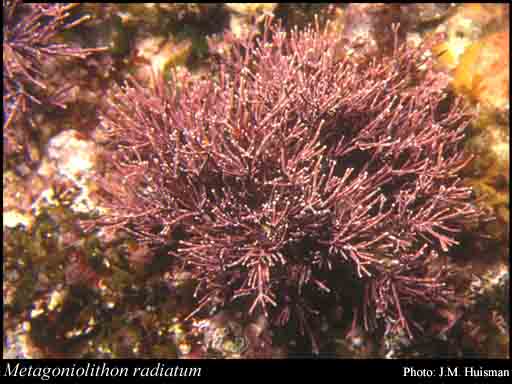
Scientific Description
Habit and structure. Thallus medium red-brown, 5–15 cm high, densely tufted with few to many erect axes from a crustose holdfast, much branched from the genicula, with few to numerous clustered branches of varying ages and lengths, intergenicula 1–2(–3) cm long below and 1–2(–3) mm in diameter, decreasing to 3–10(–15) mm long, and 400–800 µm in diameter above; branch apices covered by a mucilaginous cap 35–250 µm thick. Holdfast 2–5 mm across with several to many erect axes; epilithic. Structure. Intergenicula of numerous tiers 30–50 µm long, cells 10–15 µm in diameter with numerous lateral cell-fusions. Genicula filaments untiered. Apical cells separated, without epithallial cells. Cortex present in both intergenicula and genicula, of short splaying filaments 7–11 µm in diameter, with short epithallial cells and often bands of hairs. Rhodoplasts discoid to laminate.
Reproduction. Conceptacles uniporate, borne on the surface of the intergenicula. Gametangial thalli dioecious. Female conceptacles 700–800 µm in external diameter; carposporophyte with a broad, thin, fusion cell bearing marginal short filaments with large, terminal, ovoid, carposporangia 100–120 µm in diameter. Male conceptacles 600–800 µm in diameter, with spermatangia cut off from initials on the chamber floor. Tetrasporangial conceptacles usually numerous, 660–800 µm in external diameter, with 9–14 tetrasporangia peripheral in chambers, each tetrasporangium 110–200 µm long and 80–130 µm in diameter, zonately divided.
Distribution.Port Denison, W. Aust., to Walkerville, Vic., and around Tas.
Habitat. M. radiatum is common along rough-water coasts of southern Australia, but less so on coasts of moderate water movement.
[After Womersley, Mar. Benthic Fl. Southern Australia IIIB: 319–320 (1996)]
Distribution
- IBRA Regions
- Esperance Plains, Swan Coastal Plain, Warren.
- IBRA Subregions
- Perth, Recherche, Warren.
- IMCRA Regions
- Central West Coast, Leeuwin-Naturaliste, WA South Coast.
- Local Government Areas (LGAs)
- Augusta Margaret River, Busselton, Cockburn, Cottesloe, Dandaragan, Esperance, Irwin, Jerramungup, Rockingham, Wanneroo.