- Reference
- Bull.Torrey Bot.Club 36:80-82, Pl. 1: Figs 4, 7, Pl. 5: Figs 17-19 (1909)
- Conservation Code
- Not threatened
- Naturalised Status
- Native to Western Australia
- Name Status
- Current
Scientific Description
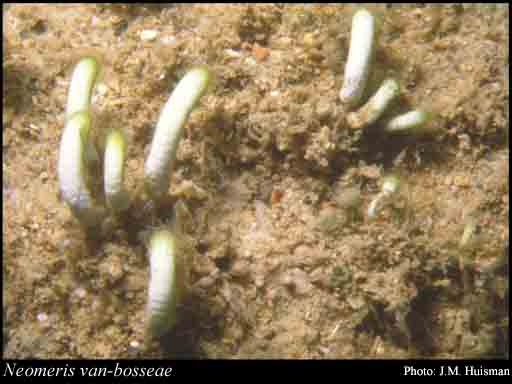
Habit and structure. Thallus clavate, to 3.5 cm tall, calcified, dark green near the apex, gradually becoming calcified and chalky white below. Structure uniaxial, with whorls of lateral branches along its entire length, 28–40 branches per whorl; primary branches to 575 µm long; secondary branches c. 400 µm long, their dilated apices c. 200 µm diam., giving rise terminally to deciduous hairs in the distal portion of the plant. Gametangia spherical, free, pedicellate, 70–100 µm diam., each bearing a single spherical cyst; when viewed externally, the gametangia resembling a layer of discrete white beads.
Distribution. Occurs in the tropical Indo-Pacific.
Habitat. Usually in small clusters on rocks in the intertidal and shallow subtidal.
[After Huisman, Algae of Australia: Mar. Benthic Algae of North-western Australia, 1. Green and Brown Algae 157 (2015)]
Distribution
- IBRA Regions
- Carnarvon, Dampierland, Pilbara.
- IBRA Subregions
- Cape Range, Pindanland, Roebourne.
- IMCRA Regions
- Kimberley, Pilbara (nearshore).
- Local Government Areas (LGAs)
- Ashburton, Broome, Karratha, Port Hedland, Wyndham-East Kimberley.