- Reference
- J.Phycol. 164 (1995)
- Conservation Code
- Not threatened
- Naturalised Status
- Native to Western Australia
- Name Status
- Current
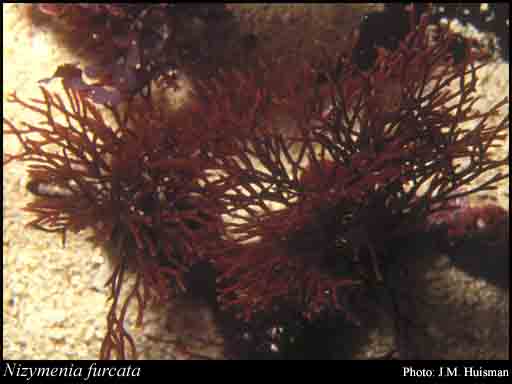
Scientific Description
Habit and structure. Thallus erect, dark red-brown, 10–25 cm high, subdichotomously and radially branched at intervals of 0.5–2 cm, branches terete, 1–1.7 mm in diameter below, decreasing gradually to 300–500 µm in diameter near the rounded apices. Holdfast discoid, 2–5 mm across, with one to a few stipes; epilithic. Structure uniaxial, with 3 or 4 periaxial cells, developing a filamentous medulla of thick-walled rhizoids 3–6 µm in diameter around the prominent axial filament 70–120 µm in diameter, with a broad pseudoparenchymatous cortex of angular cells, inner cells 15–25(–30) µm across, outer cells 4–6 µm in diameter and L/D 1–1.5. Rhodoplasts discoid, becoming ribbon shaped in inner cortical cells.
Reproduction. Sexual thalli dioecious. Cystocarps subspherical, basally constricted, 400–800 µm in diameter; carposporophyte with a central to basal fusion cell and dense, radiating gonimoblast filaments bearing terminal chains of 3–4 ovoid carposporangia 5–9 µm in diameter; pericarp thick, dense, ostiolate. Spermatangia formed on laterals (usually in threes) of uniseriate filaments 15–25 µm in diameter, arising in tufts on the thallus surface. Tetrasporangia (with only a median division) only seen on spermatangial filaments, subspherical, 12–15 µm in diameter.
Distribution. Encounter Bay, S. Aust., to Port Phillip Heads, Vic.
[After Womersley, Mar. Benthic Fl. Southern Australia IIIA: 407–408 (1994) added as Stenocladia furcata]
Distribution
- IMCRA Regions
- Central West Coast, Leeuwin-Naturaliste.
- Local Government Areas (LGAs)
- Augusta Margaret River, Cockburn, Dandaragan.