- Reference
- Ann.Mus.Natl.Hist.Nat. 43 tab. 1 figs. 4-6 (1813)
- Conservation Code
- Not threatened
- Naturalised Status
- Native to Western Australia
- Name Status
- Current
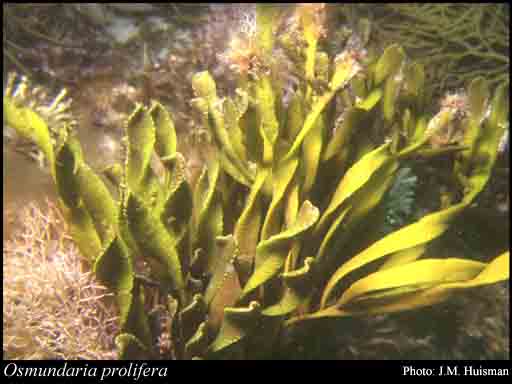
Scientific Description
Habit and structure. Thallus dark brown-red, 5–25 cm high, cartilaginous, erect, moderately branched especially near the base, usually with long ultimate branches 2–10 cm long, with narrow bases and rounded apices, branches flat, mostly 4–10 mm broad, margins smooth to closely dentate; midrib inconspicuous, lateral veins absent or inconspicuous. Surface of branches covered by a dense felt of short, branched, proliferations 0.5–1 mm long, apart from adventitious branches from lower, heavily corticated, denuded branches which remain mostly bare ("V. gregaria"). Base of branches usually denuded and thickened, 2–3(–5) mm thick near the base. Holdfast irregularly conical, 5–30 mm high and 5–15 mm broad; epilithic. Structure. Apices of branches broad, with inconspicuous apical cells, forming transverse rows of cells across the branch, with the marginal cells forming short, closely adjacent, dentations 0.5–1.5 mm long and basally 0.5–1.5 mm broad; lateral, alternate, vein system (c.f. Vidalia)absent or inconspicuous. Pericentral cells 5, 2 lateral on each side and one ventral, with a pseudopericentral cell cut off each of the dorsal lateral pericentral cells; the medulla 1–2 cells broad, cortex 1–3 cells broad. Surface proliferations multicellular, branched, some with spinous ends. Trichoblasts apparently absent. Smaller cells uninucleate, larger multinucleate; rhodoplasts discoid to elongate, becoming chained.
Reproduction. Procarps borne on short marginal shoots near branch apices, usually several on polysiphonous laterals. Carposporophytes with a prominent basal, branched, fusion cell, branched gonimoblast and clavate terminal carposporangia 30–50 µm in diameter. Cystocarps stalked, ovoid to globular, clustered on marginal out growths on upper fronds, 1.5–2 mm in diameter; pericarp with a small ostiole, 5–8 cells thick. Spermatangial organs unknown. Tetrasporangial stichidia clustered on margins of upper branches, occasionally on the branch surface, 1–3 mm long, compressed, 200–400 µm broad, corticated, with 2 tetrasporangia per segment.
Distribution.Kalbarri, W. Aust., to Victor Harbor and Kangaroo I., S. Aust.
[After Womersley, Mar. Benthic Fl. Southern Australia IIID: 404–407 (2003)]
Distribution
- IBRA Regions
- Esperance Plains, Geraldton Sandplains, Jarrah Forest, Swan Coastal Plain, Warren.
- IBRA Subregions
- Geraldton Hills, Perth, Recherche, Southern Jarrah Forest, Warren.
- IMCRA Regions
- Central West Coast, Leeuwin-Naturaliste, WA South Coast.
- Local Government Areas (LGAs)
- Augusta Margaret River, Busselton, Cambridge, Capel, Cottesloe, Dandaragan, Esperance, Greater Geraldton, Irwin, Jerramungup, Joondalup, Mandurah, Rockingham, Wanneroo.