- Reference
- Nuova Notarisia 5:627-628 (1894)
- Conservation Code
- Not threatened
- Naturalised Status
- Native to Western Australia
- Name Status
- Current
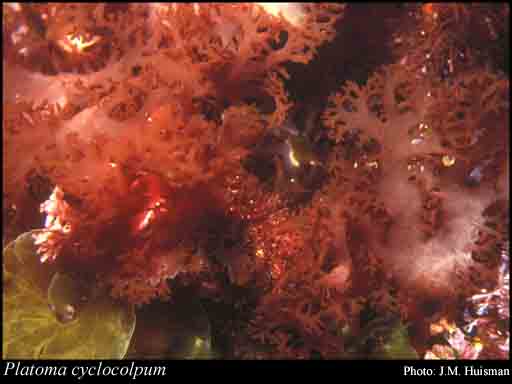
Scientific Description
Habit and structure. Thallus (gametophyte) light pink to red-brown, mucilaginous, erect or partially decumbent, pliable but turgid, to 13 cm tall and 20 cm wide, with a small discoid holdfast. Branching irregular, commonly with foliose portions and numerous marginal proliferations, rarely with narrow axes. Axes to 10–30 mm wide and 1.4–2.2 mm thick, tapering abruptly to 0.5–2.0 mm wide and 0.5–1.7 mm thick near apices. Secondary anastomoses between branches common. Structure multiaxial, with a diffuse apical meristem. Medullary filaments with cells 80–270 µm long and 5.0–15.7 µm in diameter. Cortex 5–12 cells thick, with ellipsoidal inner cells 15–35 µm long and 10–15 µm in diameter and subspherical surface cells 3.5–4.5 µm in diameter. Intercalary obovoid gland cells (25–50 µm long and 20–45 µm in diameter) common in the cortex and occasionally present in the medulla.
Reproduction. Plants monoecious. Spermatangia (4–6 µm long and 2.5–4.0 µm in diameter) in sori, solitary or paired on outer cortical cells. Generative auxiliary cells are transformed mid-cortical cells. Gonimoblast arising from the upper surface of the generative auxiliary cell, eventually producing a spherical carposporophyte 140–200 µm in diameter composed entirely of angular or spherical carposporangia 12–20 µm in diameter. Mature carposporophytes largely immersed in the thallus, although a slight protuberance and rudimentary ostiole are visible from the surface. Tetrasporangia not observed.
Distribution. Known from Cape Bouvard north to the Dampier Archipelago, W. Aust.; also on the Canary Is.
Habitat. P. cyclocolpum occurs subtidally to depths of 20 m, generally on the sides or at the bases of limestone reefs in relatively low light.
Distribution
- IBRA Regions
- Geraldton Sandplains.
- IBRA Subregions
- Geraldton Hills.
- IMCRA Regions
- Abrolhos Islands, Central West Coast, Leeuwin-Naturaliste.
- Local Government Areas (LGAs)
- Cockburn, Greater Geraldton, Joondalup, Rockingham, Wanneroo.