- Reference
- Blumea 58 (1967)
- Conservation Code
- Not threatened
- Naturalised Status
- Native to Western Australia
- Name Status
- Current
Scientific Description
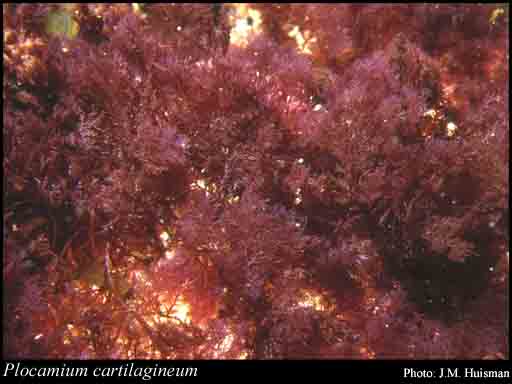
Habit and structure. Thallus slender and much branched, 5–20 cm high. Erect axes (0.7–)1–1.5 mm broad. Ramuli normally in alternate series of 3–4, occasionally in pairs or as many as 5–10; normally all ramuli except the lowest are branched, with the uppermost and sometimes the second developing as long laterals; lowest ramulus subulate to almost linear, often curved, entire, 1–2(–2.5) mm long and about 0.25 mm or less broad at its base.
Reproduction. Sexual thalli dioecious. Cystocarps sessile, globular, smooth, 0.5–0.8 mm in diameter, borne singly or several adjacent in the axils or on the margins of ramuli. Spermatangia covering the surface of ramuli and axes in apical regions. Stichidia borne in the axils of ramuli or grouped on the upper margin of ramuli and along the axes, usually simple and lanceolate at first but becoming branched at wide angles near their upper ends, sometimes subdichotomously branched 1–4 times lower down; individual stichidia (150–)250–400(–1000) µm long and 80–100 µm in diameter, with a short pedicel. Tetrasporangia biseriate, ovoid, 40–55 µm long and 27–32 µm in diameter, zonately divided.
Distribution. Temperate seas throughout the world. In Australia, from Shark Bay, W. Aust., around southern coasts to Newcastle, N.S.W. (probably to Caloundra, Qld) and around Tas.
Habitat. Found on coasts of strong to moderate wave action and known from depths of 2–26 m.
[After Womersley, Mar. Benthic Fl. Southern Australia IIIA: 389–391 (1994)]
Distribution
- IBRA Regions
- Jarrah Forest, Warren, Yalgoo.
- IBRA Subregions
- Edel, Southern Jarrah Forest, Warren.
- IMCRA Regions
- Central West Coast, Leeuwin-Naturaliste, WA South Coast.
- Local Government Areas (LGAs)
- Albany, Augusta Margaret River, Carnarvon, Cockburn, Esperance, Manjimup, Rockingham.