- Reference
- Nereis australis 122 (1849)
- Conservation Code
- Not threatened
- Naturalised Status
- Native to Western Australia
- Name Status
- Current
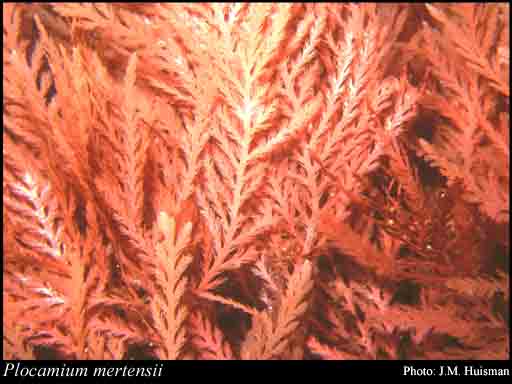
Scientific Description
Habit and structure. Thallus 10–50 cm high, much branched with spreading laterals. Erect axes (1–)2–3(–5) mm broad, thin and delicate in younger regions which are usually broader than older parts of axes. Ramuli in alternate pairs; upper ramulus divided, often developing into a lateral branch, lower ramulus subulate, (0.7–)1–1.5(–5) mm long and usually less than 0.25 mm broad at its base, entire or serrate in its upper part either on the abaxial edge only or on both edges; lower ramulus frequently becoming divided and often proliferating into dense clusters of sub-dichotomous pinnules which may occur commonly on older branches, or on occasional branches, or be totally absent in some plants.
Reproduction. Sexual thalli dioecious. Cystocarps in axils of either of the two ramuli, 1–2(–3) maturing, globular and pedicellate, 0.5–0.8(–1) mm in diameter, arising on small branchlets in the axils. Spermatangia covering the surface of terete branchlets in dense axillary clusters. Stichidia in dense hemispherical clusters arising from a pad of tissue in the axil of either ramulus or of laterals; individual stichidia simple or branched basally only, linear, 0.25–0.5(–1) mm long and (50–)75–100(–125) µm in diameter, becoming curved as they elongate; occasional old elongate stichidia become branched near their apex. Tetrasporangia in 1 or 2 series, ovoid, 50–75 µm long and 25–50 µm in diameter, zonately divided.
Distribution.From Nichol Bay, W. Aust., to Gabo I., Vic., and northern Tas.
Habitat. Found on coasts of strong to moderate wave action and known from shaded pools near low tide level to 50 m deep.
[After Womersley, Mar. Benthic Fl. Southern Australia IIIA: 383–385 (1994)]
Distribution
- IBRA Regions
- Esperance Plains, Geraldton Sandplains, Jarrah Forest, Swan Coastal Plain, Warren.
- IBRA Subregions
- Geraldton Hills, Perth, Recherche, Southern Jarrah Forest, Warren.
- IMCRA Regions
- Abrolhos Islands, Central West Coast, Eucla, Leeuwin-Naturaliste, WA South Coast.
- Local Government Areas (LGAs)
- Albany, Augusta Margaret River, Busselton, Cambridge, Cockburn, Coorow, Cottesloe, Dandaragan, Esperance, Fremantle, Greater Geraldton, Irwin, Mandurah, Manjimup, Northampton, Rockingham, Wanneroo.