- Reference
- Bot.Zeitung (Berlin) 3:54-55 (1845)
- Conservation Code
- Not threatened
- Naturalised Status
- Native to Western Australia
- Name Status
- Current
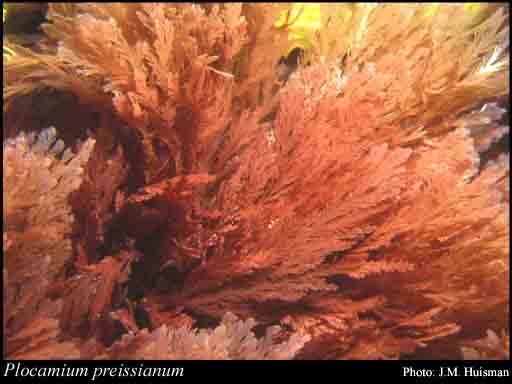
Scientific Description
Habit and structure. Thallus robust, 20–50 cm high. Erect axes (1–)1.5–2(–3) mm broad, usually long and irregularly branched, becoming thickened and sometimes appearing costate in older parts. Ramuli in alternating series of 3(–4), occasionally with some in pairs in certain plants, the uppermost ramulus (occasionally the upper two) usually developing into a lateral branch; lower ramuli subulate to linear, (1.5–)2–3(–4) mm long and (200–)300–400(–500) µm broad at their base, usually strongly serrate abaxially (rarely entire).
Reproduction. Sexual thalli dioecious. Cystocarps single or occasionally adjacent, sessile on the axis or on either margin of the ramuli or sessile in comparable positions on small axillary branchlets, 0.7–1(–1.5) mm across, globular and becoming strongly verrucose. Spermatangia covering extensive areas on both surfaces of young apices and ramuli. Stichidia in dense axillary clusters and frequently extending along the margins of the adjacent axis and ramuli; individual stichidia simple or basally branched only, linear-arcuate, (100–)200–500 µm long (sometimes continuing growth to 1.5 mm long) and (25–)50–75(–100) µm in diameter. Tetrasporangia in 1–2 series, ovoid, 53–66 µm long and 40–53 µm in diameter, zonately divided.
Distribution.From the Abrolhos Islands and Geraldton, W. Aust., to Wilsons Prom., Vic.
[After Womersley, Mar. Benthic Fl. Southern Australia IIIA: 387–389 (1994)]
Distribution
- IBRA Regions
- Geraldton Sandplains, Jarrah Forest, Swan Coastal Plain, Warren.
- IBRA Subregions
- Geraldton Hills, Perth, Southern Jarrah Forest, Warren.
- IMCRA Regions
- Abrolhos Islands, Central West Coast, Leeuwin-Naturaliste, Ningaloo, WA South Coast.
- Local Government Areas (LGAs)
- Augusta Margaret River, Busselton, Cambridge, Carnarvon, Cockburn, Cottesloe, Dandaragan, Esperance, Exmouth, Greater Geraldton, Irwin, Joondalup, Nedlands, Rockingham, Wanneroo.