- Reference
- Fragm. (Mueller) 6:229 (1868)
- Conservation Code
- Not threatened
- Naturalised Status
- Native to Western Australia
- Name Status
- Current
Prostrate to scrambling shrub, 0.3-1.5 m high. Fl. white-cream/pink-purple, Sep to Dec. Sandy soils, laterite.
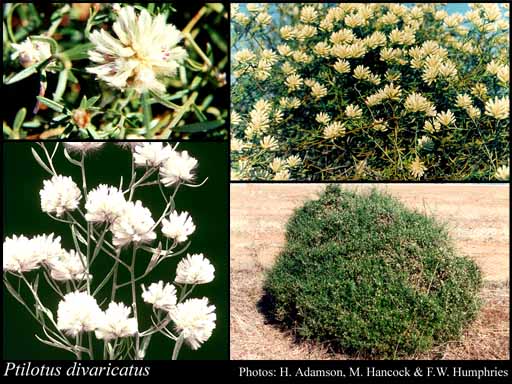
Scientific Description
Shrubs or perennial herbs, stems single or several, more or less erect, glabrescent, with nodose hairs. Leaves present, 5-45 mm long, 1-5 mm wide, glabrescent or glabrous, with nodose hairs; basal rosette absent; cauline leaves alternate. Spikes white or pink, ovoid, hemispherical or spherical, clustered, with densely arranged flowers. Bracts 4-4.5 mm long, colourless, glabrous or hairy, not awned or mucronate, with a prominent midrib. Bracteoles 5.5-6.5 mm long, colourless, glabrous, not awned or mucronate, with an obscure midrib. Outer tepals 9.5-15 mm long, entire or not entire. Inner tepals 9-14.5 mm long, with a basal tuft of hairs on inner face. Style (2.5-)4-4.6 mm long, straight, obliquely fixed to ovary. Seeds 1.4-1.6 mm long, dull, orange or pale brown. Distribution: South West and Eremaean Botanical Region; IBRA regions: Carnarvon, Coolgardie, Gascoyne, Murchison, Pilbara.
Distribution
- IBRA Regions
- Avon Wheatbelt, Carnarvon, Coolgardie, Gascoyne, Geraldton Sandplains, Jarrah Forest, Murchison, Pilbara, Swan Coastal Plain, Yalgoo.
- IBRA Subregions
- Ashburton, Augustus, Cape Range, Carnegie, Eastern Goldfield, Eastern Murchison, Edel, Geraldton Hills, Katanning, Lesueur Sandplain, Merredin, Northern Jarrah Forest, Perth, Roebourne, Southern Cross, Tallering, Western Murchison, Wooramel.
- IMCRA Regions
- Abrolhos Islands, Central West Coast, Pilbara (nearshore), Shark Bay.
- Local Government Areas (LGAs)
- Ashburton, Bruce Rock, Carnarvon, Chapman Valley, Coolgardie, Coorow, Corrigin, Cunderdin, Dalwallinu, Dowerin, Dundas, Exmouth, Goomalling, Greater Geraldton, Irwin, Karratha, Laverton, Leonora, Meekatharra, Menzies, Mingenew, Moora, Morawa, Mount Magnet, Mount Marshall, Murchison, Murray, Narembeen, Northam, Northampton, Perenjori, Port Hedland, Quairading, Sandstone, Shark Bay, Tammin, Three Springs, Toodyay, Trayning, Upper Gascoyne, Victoria Plains, Wiluna, Wongan-Ballidu, Yalgoo, Yilgarn, York.